PROFILE: Dalhousie professor and Ocean Alkalinity Enhancement researcher, Katja Fennel, talks about both the challenges and the possibilities inherent in the science and how she went from skeptic to supporter.
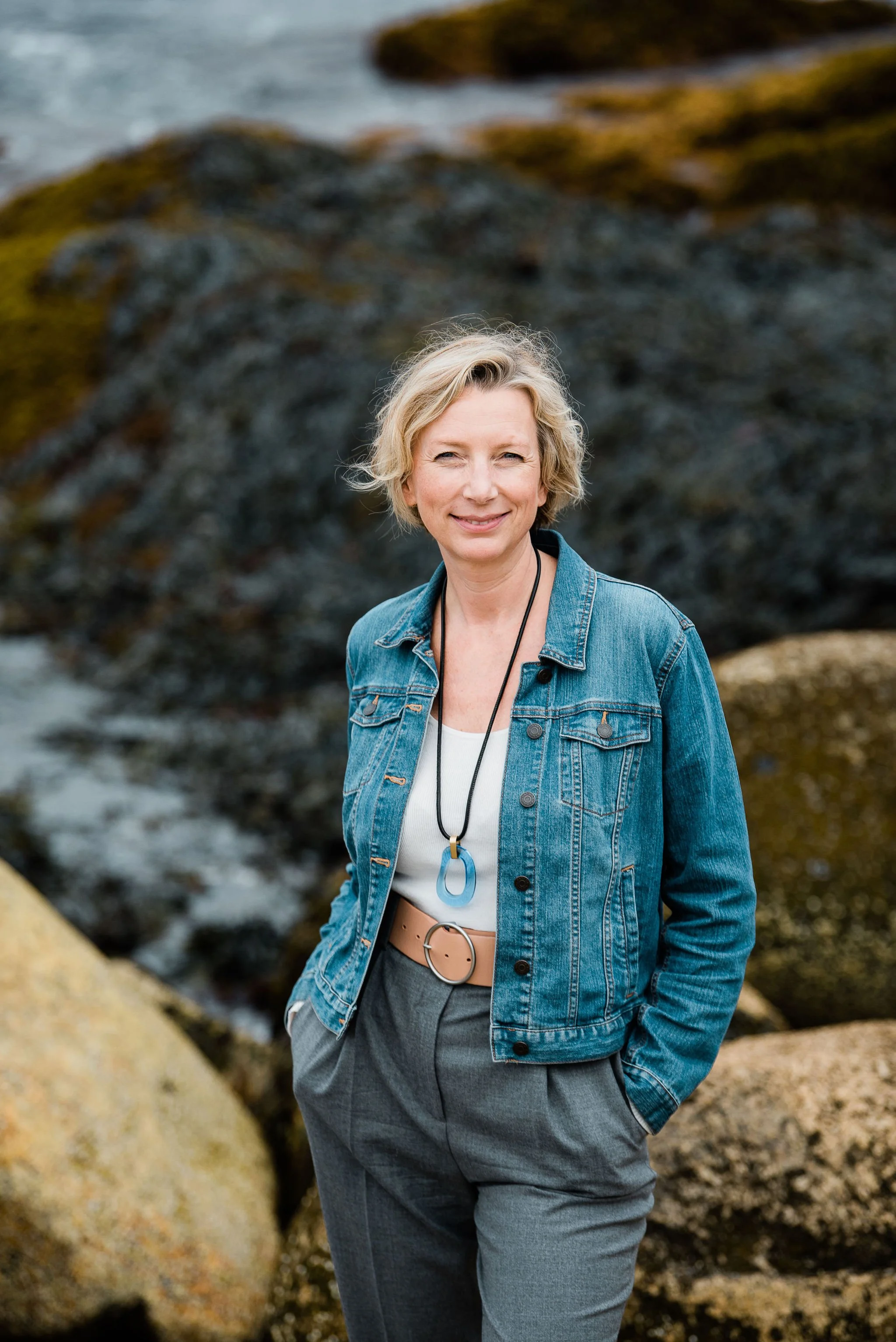
Katja Fennel. Photo courtesy of Katja Fennel.
Katja Fennel has spent much of the last five years studying the potential of ocean alkalinity enhancement (OAE) to pull carbon dioxide out of the atmosphere.
It’s the kind of research she was once vehemently opposed to.
“I've heard about deliberate ways of regulating climate ever since I was a graduate student, but it was always sort of fringe and very suspect to me,” says Fennel, a professor of oceanography and former Canada Research Chair at Dalhousie University. “I was actually quite adamant that I wasn't going to get involved in that kind of research.”
The reason? The most urgent need when it comes to slowing climate change is reducing emissions.
Fennel worried that developing carbon dioxide (CO2) removal technologies could lead to the belief that, if we can take CO2 out of the atmosphere, we won’t need to curb emissions.
But “nothing could be further from the truth,” she says.
So why is she now a leading OAE researcher? Because, she says, “We're in a situation where it's getting more and more urgent that we not only cut emissions but also start thinking in earnest about whether we can come up with ways to deal with the legacy CO2 in the atmosphere. And [ocean] alkalinity enhancement is one that could work.”
The science behind OAE
The world’s ocean holds an enormous amount of dissolved carbon dioxide — 50 times more CO2 than what’s in the atmosphere, Fennel says.
Fennel calls the chemical behaviour of carbon dioxide in seawater “interesting, fascinating, and complicated.”
She explains, “When CO2 dissolves in seawater, because of the alkaline characteristic of seawater, it first forms carbonic acid [H2CO3], and then carbonic acid dissociates into a different sequence of ions — bicarbonate ions, carbonate ions and hydrogen ions, or H+.”
The more H+ ions there are in a solution, the more acidic it becomes.
Fennel adds, “CO2 dissolves in the ocean but then gets pushed into these other ions, so there's a big reservoir of these dissolved ions in the oceans.”
The ocean is naturally alkaline, and increasing that alkalinity, even by a tiny amount, would allow it to absorb even more carbon dioxide, and help reverse some of the ocean acidification caused by centuries of industrial activity.
Over time, the tendency is for the ocean to naturally become more alkaline as it absorbs minerals from rocks eroding and dissolving steadily, due to rainfall and other forces. But that’s a process that works on a geological timescale, which, Fennel says, “doesn’t help us.”
Alkalinity enhancement essentially speeds up that natural process.
There are different approaches to OAE. The one being tested by Halifax-based company Planetary Technologies involves dissolving antacids such as magnesium hydroxide and magnesium oxide into ocean waters near existing outfalls.
Fennel, who says her research team is “working closely” with Planetary Technologies, but is independent from them, studied the effects of the Halifax test, and said the results are “promising.”
But there is a limit to how much material can be added before the process becomes counter-productive.
“One of the things we’re looking at specifically now with our modelling system is the hydrodynamics. If you have an outfall, you're trying to put in as much alkalinity as you can, but without reaching the regulatory limit of pH 9,” she says.
There’s also what she calls a “geochemical limit”: add too much material and you can get runaway calcium carbonate precipitation, which turns the water milky and “will erase the alkalinity that you've painstakingly and expensively put in.”
Growing up by the sea
Fennel grew up in the former East Germany, in the small town of Warnemünde, on the Baltic Sea. As a child, she had an interest in both art and the environment, and “was on the beach pretty much every day.” Living in an authoritarian state with a planned economy, Fennel opted to study mathematics because she “didn’t want to be a cog in the wheel that propped up the system” and math seemed like a subject “removed from ideological interference.”
The Berlin Wall came down soon after she finished Grade 12, but she decided to stick with math, earning the equivalent of a master’s degree with a specialization in numerical mathematics. That could have led Fennel to a lucrative career in banking or insurance, but she was looking for something more creative and interesting.
So she went into oceanography, following in her oceanographer father’s footsteps, despite his wishes. “I can tell you that he said, ‘Whatever you do, don't do oceanography,’” Fennel says. “Maybe I'm also in oceanography because of him, you know — maybe it was just impossible for me to obey that directive.”
Her background in mathematical modelling has served Fennel well as an oceanographer, as she writes computer models that simulate the circulation of the ocean, and the effects of biological and chemical processes in the marine environment.
She moved to the United States in 1999 for a post-doc in Oregon, then became a professor at Rutgers University, before taking a job at Dalhousie in 2006.
A healthy dose of skepticism
As someone who was originally skeptical herself, Fennel understands that not everyone thinks OAE is a good idea.
At the same time public attitudes toward carbon removal have evolved. Recent Canadian polling found broad support for carbon removal, including marine carbon dioxide removal, across political and regional lines.
There are other approaches to OAE beside Planetary’s. Another Nova Scotia-based company proposes capturing CO2 from power plants, using a slurry of limestone and seawater to transform it into bicarbonate, and storing it in the ocean. A third approach involves removing seawater from the ocean, electrochemically splitting certain minerals into the water into positive and negative ions, and, says Fennel, “taking the acidic component out, and leaving the alkaline minerals behind.”
The energy requirements of OAE vary significantly depending on the approach. Fennel cautions that if that energy comes from burning fossil fuels, the emissions risk nullifying any benefits. Those methods only become viable if we decarbonize energy production.
And there are unknowns. Speaking to Canada’s Standing Senate Committee on Fisheries and Oceans in October 2025, marine research scientist Helen Gurney-Smith said when it comes to using the ocean to remove carbon dioxide from the atmosphere, “Unfortunately, we are not at the level that we can have a scientific consensus where we can be firmer about these things. We need more research in key areas, such as around fish and shellfish production.”
Research in these areas has continued to expand. Since 2024, the Joint Learning Opportunity has supported OAE-focused research involving multiple research groups, while studies associated with the Tufts Cove field trials have also examined potential biological and ecological effects.
What will it take to scale up?
Localized results are one thing, but if OAE is going to make a difference in mitigating climate change, it’s going to have to scale up — a lot. Fennel says we’ll need to remove at least one gigatonne (“that’s a one with nine zeros”) from the atmosphere per year. Current deployments remain small relative to the gigatonne scale ultimately needed for carbon removal to make a meaningful global contribution.
Fennel has been working on modelling the number of Tufts Cove-like locations it would take to scale OAE globally. Her “tentative guess” is that getting to a gigatonne would take 43,000 sites around the world. And if the locations are less conducive, “We’re talking on the order of 100,000” she says.
That estimate is based on Tufts Cove-like sites and does not represent the capacity of all potential deployment locations. Site capacity can vary significantly depending on water flow, infrastructure and local conditions. Other modelling suggests that Canada’s coasts alone could support tens of millions of tonnes of CO₂ removal annually.
Is it a tall order? Yes. Will it work? Well, maybe.
“We’re making progress on the modelling and the observations, but I don’t want to give the wrong impression here. I would put it at 50/50 at this point, whether this is going to work or not — with a large uncertainty bar right in the middle.”
But even if OAE is a smashing success, Fennel reiterates that it’s not a substitute for the most important climate change mitigation strategy.
“I would, at the beginning and at the end, emphasize that this is not a substitute for emission reduction,” she says. “We need to reduce emissions.”
***
This story is part of a special series on marine-based climate solutions that is supported by the Carbon to Sea Initiative, the Marine Environmental Observation, Prediction and Response Network (MEOPAR), and Planetary Technologies.