What a family road trip taught us about EV travel in Nova Scotia, New Brunswick, and Quebec.
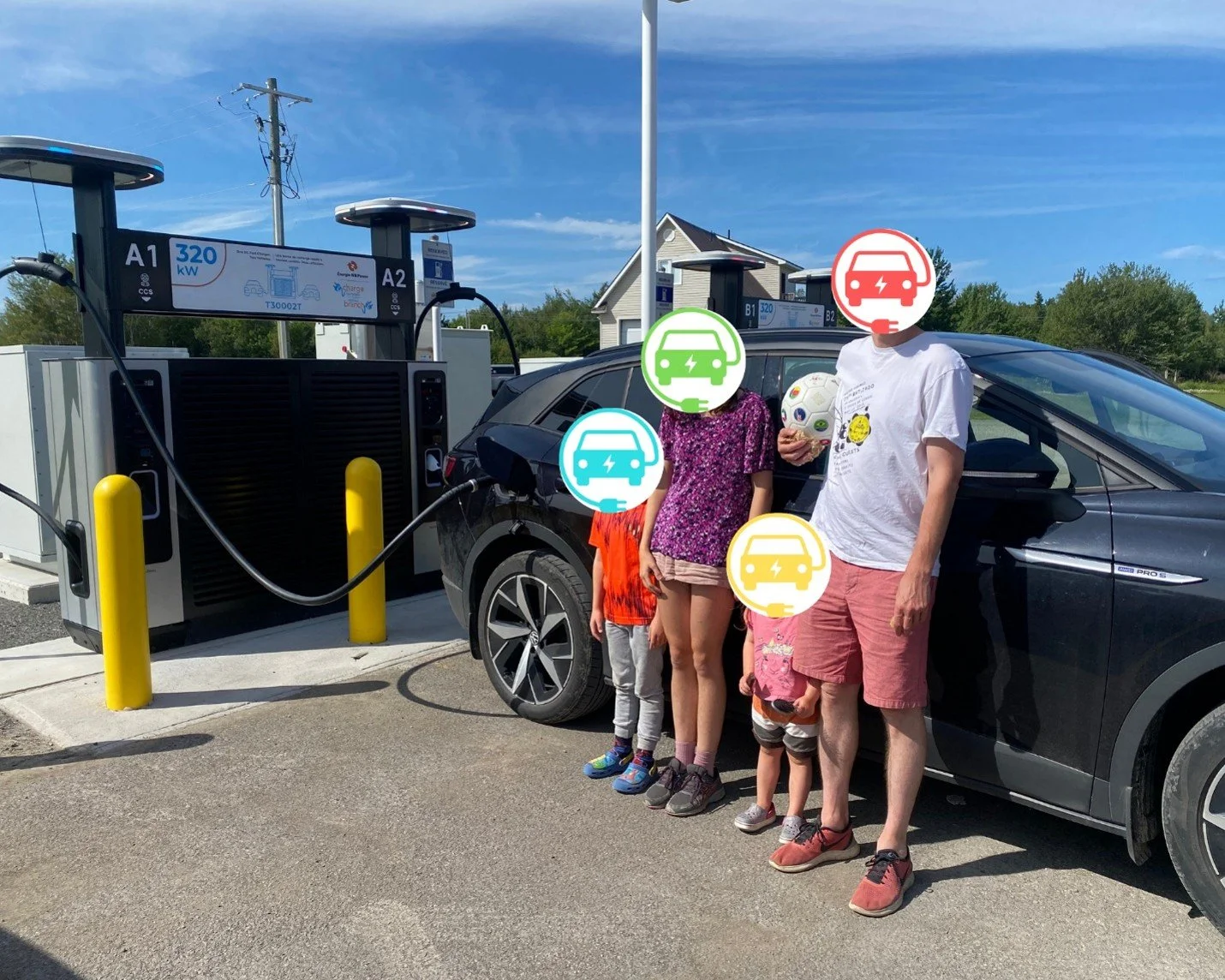
Electrified travelers (AKA my family and our 14-year-old friend and travel companion) at the brand new 320 kW chargers in Bouctouche, NB. Photo courtesy of Mary-Frances Lynch.
Electric vehicle (EV) ownership is on the rise, but a recent CAA survey shows some EV drivers are still hesitant to make longer trips. Most still own a gas car, likely for extended journeys where range anxiety is too much to bear. To put this concern to the test, our young family set out on a 2,000 km road trip from Halifax, Nova Scotia to Gaspé, Québec in our EV.
We wanted to understand how the EV family road trip holds up in rural Atlantic Canada and how EVs change the travel experience. Spoiler – the long EV road trip is totally do-able and seriously cost-effective but comes with a few lessons learned. (Side note: the trip cost us $150 in charging fees, half of the cost of gassing up a similarly-sized VW Tiguan at $1.86/L).
With our Volkswagon ID.4 packed to the brim, we set out with a 100% charge, a 400km range, a mountain of snacks, our 2- and 6- year olds, and a 14 year old friend. In preparation, we had mapped our route in the A Better Route Planner app to review fast chargers enroute. Even with our pick of fast chargers, we had to be smart about our stops - to reduce range anxiety, our strategy was to stop often.
Our first charging stop, 110km up the road at the Masstown Market in Nova Scotia, was unnecessary charge-wise yet offered a few unwanted surprises. It was a busy Sunday, and so upon arrival, three of the four fast charger’s ports were occupied, with the remaining one incompatible with our car. We waited 45 minutes for a charger only to find the charge kept on stopping, charging only 7 minutes. A fellow EV driver had the same issue before they too gave up. We weren’t off to the best start, but since we didn’t need the charge, we continued on.
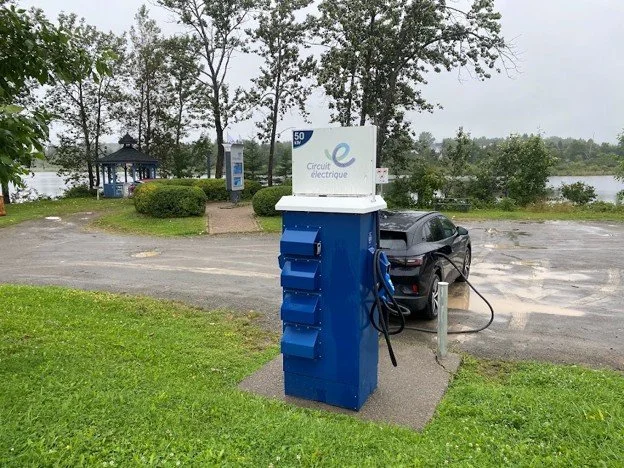
Charging up in Chandler, QC at their waterfront 50 kW charging station. Photo courtesy of Mary-Frances Lynch.
Our luck turned around next at a brand-new charger, installed this past July at the Auberge Bouctouche Inn off Route 11 in New Brunswick. Here, there was no wait for the four 100 kW fast chargers, all compatible with our car. A field next to the charger, perfect for a spontaneous soccer match, plus clean washrooms at the nearby hotel made for both fun and a necessary washroom break.
Things kept getting better once we crossed into Québec and accessed the Circuit électrique. Here coverage is extensive, with seemingly more EV chargers than poissoneries, which is saying something in Gaspésie. In Québec we charged up in Pointe à la Croix, Carleton-sur-Mer, Chandler, Percé, and Gaspé with virtually no issues nor wait times. Percé’s fast chargers at Club Nautique, with views of the iconic pierced rock and a big marine-themed playground, was a clear winner.
One of our biggest discoveries was a practical one made at our last charging stop in Shediac, New Brunswick. A fellow EV driver shared that Québec’s Circuit électrique app has partnerships with 19 charging networks, including those in New Brunswick and many in Nova Scotia, allowing you to pay with that app at those chargers. This tip was invaluable since the myriad of payment methods, apps and account signups for each charger was one of the more tedious parts of the trip. For our next long journey, we’ll exclusively use the Circuit électrique app for consistent payment and tracking.
What surprised me most was just how well-suited EV travel is to the family road trip. With young kids, you need to stop often for washroom-, snack- and stretch-breaks, and so a travel pace slowed by charging stops goes unnoticed. From our experience, we savoured the stops. Over our weeklong holiday, we made 13 charging stops, totaling 6 and a half hours of charging time (when car was plugged in). Enjoying a buffet breakfast in Eel River Bar First Nation (NB), climbing into a giant coffee cup in Chandler (QC), and playing soccer in Bouctouche (NB) left us with memories of new places that we would not have visited without needing to stop and charge.
For our family, we are sold on long-distance EV travel. It’s not that hard of a sell. The trip is totally do-able and made smoother with some advance planning to map out stops. A co-navigator to look up charging stations for inevitable spontaneous stops to accommodate younger travellers is helpful too. Slower chargers are cost effective and work well for longer mealtime or overnight stops, and simply charging up regularly, no matter how short, reduces range anxiety.
In addition to the 187 Canadian flags spotted on our journey, we saw just how reliable EV charging infrastructure is in this part of the region (especially in Québec), and with millions of dollars of planned investment in EV chargers in Nova Scotia and New Brunswick, the journey will be even more seamless in coming years. My advice to families considering taking that longer trip in an EV in at least our part of Atlantic Canada – drive, charge and discover.
Climate Stories Atlantic is an initiative of Climate Focus, a non-profit organization dedicated to covering stories about community-driven climate solutions.
Sign up for notifications of our latest free articles. You can unsubscribe at any time.