The acid test
How are river- and ocean-dwelling creatures closer to the bottom of the biological rung experiencing increased ocean and river acidification as a result of climate change? And how do they seem to be responding to 'antacid' treatments to help right the pH balance?
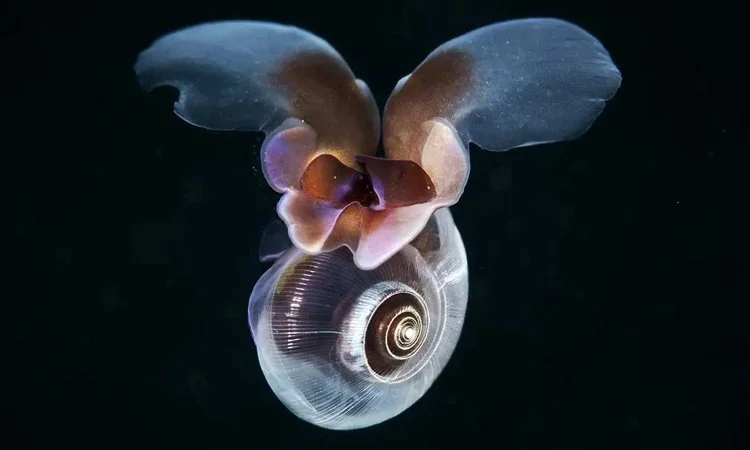
A sea butterfly in mid “flight”. Tiny marine snails that move through the water using winglike flaps. Photo courtesy of oceaninfo.com
Ocean acidification storms are just what they sound like — localized, prolonged, and intense episodes of acidity which settle, like heat domes, over stretches of coastline to the detriment of local wildlife. They aren’t new, but they are getting worse, an extreme manifestation of ocean acidification, not unlike extreme weather in a warming climate.
“It’s already changed more in the last few years than it has in the last several decades combined,” says Iria Gimenez, research scientist with British Columbia’s Hakai Institute. “How long these storms persist, how corrosive they get, and their geographical extent is increasing.”
While drops in pH are slow and predictable in the open ocean, acidic swings are common on the coast, where chemistry is complicated by influxes of freshwater, and where these storms tend to descend. Calcifiers, like oysters and mussels, are hit especially hard, obligated, as they are, to build shells from calcium carbonate, and to maintain those shells in an increasingly corrosive ocean. The metabolic toll can be enormous, and for younger life stages, like larvae, it’s lethal. Sea butterflies — in actuality, slugs — are more resistant to acidity than most, coating their shells with protective membranes which resist corrosion, but in today’s ocean, they’re also dissolving.
“Calcifiers have gotten a lot of attention,” says Gimenez, “but we already know they’re not the only ones effected.”
Zooplankton — near the base of oceanic food chains — appear to be shrinking in an acidified ocean, the smaller of which, with lighter fat reserves and less protein, are for some reason outperforming their larger, more nutritious cousins, which means fewer calories and macronutrients climbing the dietary ladder. Among fish, excess acidity is altering behaviour, disrupting the neurotransmitters involved in finding prey, or avoiding predators. And on and on, everything pointing to a less productive ocean.
“I’m fairly certain that it’s going to get really bad,” says Gimenez. “We’re in for some pretty dramatic changes.”
Winners and losers
Ocean Alkalinity Enhancement (OAE) is, in its way, the polar opposite of an acidification storm. While the latter relies on an excess of carbon dioxide and a shortage of antacids in a given stretch of ocean, OAE actively mixes in antacids like calcium hydroxide, magnesium hydroxide, and sometimes calcium carbonate to react out dissolved carbon dioxide, yielding free floating carbonates and bicarbonates.
In this way, OAE sequesters carbon dioxide, and, if all goes to plan, eventually empowering treated oceans to absorb still more from the atmosphere. The idea is to reverse some global warming, but since the carbon dioxide warming the globe is also the carbon dioxide acidifying the oceans, OAE necessarily raises pH, fuelling the notion that it could benefit wildlife.
“Conceptually,” says Will Burt, vice president of science and product with Planetary Technologies, an OAE startup in Halifax, Nova Scotia, “the effect you’re having is the opposite of ocean acidification, but it’s more complicated than that.”
For one thing, the ocean is a very big place, and at present scales — a few thousand tonnes of antacid per year — OAE is a drop in the bucket. Planetary’s chemical impact on Halifax Harbour becomes undetectable about a kilometre away from the treatment area, and pales in comparison to that of local wastewater treatment plants. Even if OAE climbs into the hundreds of megatonnes of antacid per year — Burt considers this a feasible target for the industry by 2050 — its alteration of ocean chemistry would remain extremely localized, dissipating quickly with distance from shore.
Another point is that OAE deploys some complicated compounds. Planetary’s antacids are magnesium hydroxide and calcium hydroxide, and in both cases, it’s the hydroxide sequestering the carbon. The magnesium and calcium are just along for the ride, and while both occur naturally at high concentrations in every ocean, the addition of a few hundred megatonnes via OAE requires careful study and observation, to ensure the safety of the ecosystems receiving them. There’s also the question of impurities, of which OAE projects must always be cautious.
“What we should expect to see are some minor shifts in microbial communities in these very small patches of treated water,” says Burt, “then the question becomes, does that matter?”
This is more or less what’s been shown by the literature — demographic shifts in phytoplankton and zooplankton communities exposed to the antacid treatments of OAE. Planetary’s treatment at Tufts Cove in the Halifax Harbour seems to be following suit, says Burt, “winners and losers,” with some species flourishing from the heightened pH, magnesium, and calcium, and others pining for the lost acidity. But Burt’s priority is less to prove a benefit to wildlife, than to prove a lack of harm.
“That’s where the bulk of our work is focused,” he says.
All rivers run to the sea
Nova Scotia’s West River, in Sheet Harbour was, prior to the 1990s, one of the most productive salmon rivers in the Maritimes, but then came acid rain, stripping its sparce soils of naturally occurring antacids like calcium carbonate, without which the river’s pH dropped to ludicrously and chronically low levels.
“There were some years when we had two or three thousand salmon coming back to this river,” says Eddie Halfyard, one time research scientist with the Nova Scotia Salmon Association. “By 2005, there were maybe a couple hundred.”
Excess acidity liberates some nasty metals in freshwater, like aluminum, toxic to salmon and trout. Acidity also toys with the ability of their cells to efficiently uptake oxygen, and appears to mess with their neurotransmitters, as has been observed in the open ocean. Here, too, acidity shrinks the base of freshwater food chains, favouring smaller and less nutritious species of zooplankton, which means fewer calories make their way to fish.
Another consequence of poor pH — and this one’s weird — is that marine predators, like Double-Crested cormorants, learn to congregate at the mouths of acidified rivers. This appears to be because juvenile salmon, stressed by acidity, swim closer to the surface when transitioning to ocean life. They’re more visible from the air, and thus easier prey, resulting in entire generations being annihilated by swarming seabirds.
“It’s just a killing field,” says Halfyard.
There was a ready solution to all this river carnage — RAE (River Alkalinity Enhancement). The Scandinavians have been dosing acidic rivers with calcium carbonate (powdered limestone) for decades to recover fish stocks, and the oyster and mussel hatcheries of Oregan and Washington struck upon the same solution when acidified waters from the Pacific Ocean began killing their larvae in the mid-2000s. Add calcium carbonate and pH climbs, and as we know now, carbon dioxide is also sequestered in the process. It is, in fact, difficult to do one without the other in waters this acidic.
The Nova Scotia Salmon Association has been dosing West River Sheet Harbour since 2005, with automated “lime dosers” erected on shore, mixing in measured sums of calcium carbonate year-round. Atlantic salmon are recovering, at least in the branches of river receiving limestone.
But in 2022, Eddie Halfyard turned this equation on its head, leaving the Nova Scotia Salmon Association to co-found CarbonRun, a startup whose goal is to sequester carbon dioxide by dosing some Nova Scotia rivers with limestone, funded by the sale of carbon credits, rather than the flaky grants available for freshwater conservation. Same equipment, same dosing regime, same outcomes, different deliverables.
They’ve since deployed dosers in West River (different from West River Sheet Harbour) and Moser River, Nova Scotia, with more planned in Quebec. They’ve also gone international, pairing existing lime dosers in Europe (built to restore salmon) with carbon credits of their own, in some cases restarting dosers which had gone quiet for lack of conservation funding. Many more projects are under development.
The benefits of OAE for wildlife are clearest in rivers, says Halfyard, where the extreme acidity of water, the small scales involved, and the ubiquity of calcium carbonate allows even modest doses to have outsized impacts. River liming also has decades of safety and efficacy research behind it, allowing CarbonRun to choose the most appropriate watersheds for the dual benefits of habitat restoration and carbon sequestration with more confidence than most OAE.
“It has to be the right river,” says Halfyard, “chemically and ecologically.”
Think local
OAE has a long way to go, said Gimenez, not only to sequester carbon at relevant scales, but to ensure the safety of ecosystems being dosed.
“There’s still a lot we don’t know,” she says. “The science can’t keep up, and the regulatory frameworks absolutely can’t keep up.”
But in theory, and at scale, she says OAE could have clear benefits for wildlife outside the acidic rivers of CarbonRun. It could be applied to urban runoff, for example, blunting its acidity before that acidity reaches the ocean. It might be paired with oyster and mussel hatcheries, which presently use sodium carbonate, but which could use more reactive compounds like calcium hydroxide and magnesium hydroxide to sequester more carbon dioxide and possibly even generate carbon credits.
Most evocatively of all, she says OAE might one day be deployed in coastal ecosystems where ocean acidification storms are chronic, and where communities of calcifiers, such as oyster reefs, could derive the most benefit. In this scenario, acidification storms might be confronted by antacid plumes, sheltering species who might otherwise dissolve. But a lot of careful observation, and good science needs to take place before any such arrangements can even be contemplated. Even then, these theoretical benefits wouldn’t reach the open ocean, which, she says, can only be rescued by decarbonization, not OAE.
“I want to emphasize local,” says Gimenez. “The moment you put alkalinity into the ocean, it’ll get washed away depending on the hydrodynamic conditions of your region [though ultimately still beneficial in terms of driving additional CO2 removal] It has to be at the right place, at the right time, and at the right magnitude.”
This story is part of a special series on marine-based climate solutions that is supported by the Carbon to Sea Initiative, the Marine Environmental Observation, Prediction and Response Network (MEOPAR), and Planetary Technologies.