A balancing act: a chat with marine biologist, Dr. Julie LaRoche
PROFILE: Marine biologist, Julie LaRoche, finds beauty in the ocean’s tiniest inhabitants and, through her OAE research, is working to ensure they stay as happy and healthy as possible under her watch.
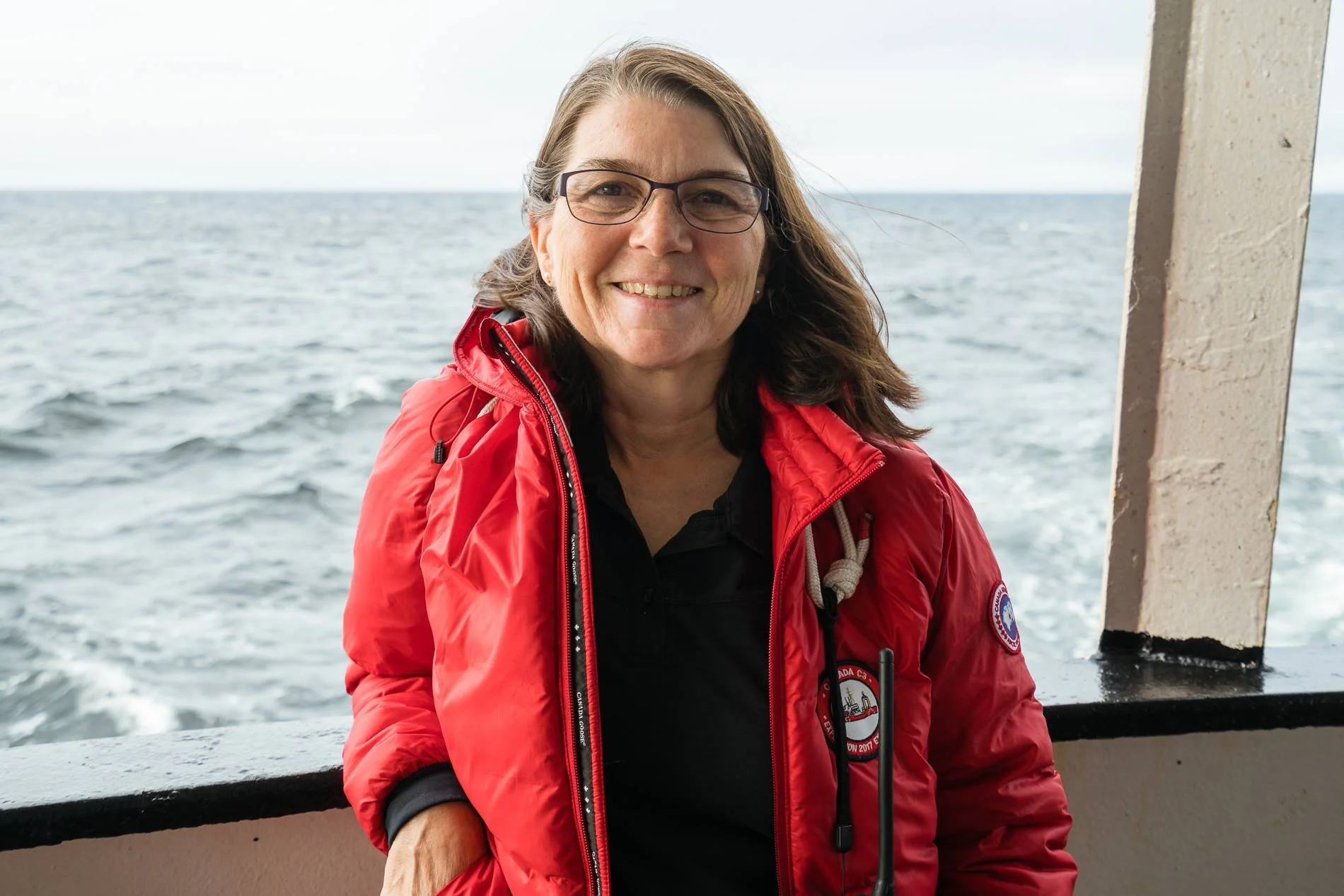
Dr. Julie LaRoche being her happiest marine biologist self out on the open ocean. Photo courtesy of Planetary Technologies.
Dr. Julie LaRoche has French oceanographer Jacques Cousteau to thank for where she finds herself today.
“My dad and I, on Sunday nights, we would always watch nature shows,” she says, “so Jacques Cousteau is actually the person who drove me to oceanography.”
The professor and marine biologist in Dalhousie University’s Department of Biology is, like many smart people doing work that may save us all one day, soft spoken, modest, and humble. A tier one Canada research chair in Marine microbial geonomics and bio geochemistry, she's also working in conjunction with Halifax's Planetary Technologies on ocean alkalinity enhancement research.
Hailing from Quebec City, LaRoche says she's been interested in the natural world as long as she can remember.
”As a child, I was like, I love these beautiful, you know, butterflies and insects and plants,” she says. “When I was 3, I was digging up worms in somebody's garden and putting them in a bucket.”
LaRoche, who says, unbelievably, that she knew she wanted to be a biologist at 9, and by 11, an oceanographer, obviously fulfilled that goal, graduating from McGill University with a degree in Biology (specifically, Marine biology) before landing her first job in the field after graduating, finding herself studying coral in Barbados. From there, she says, her interest just went “smaller and smaller.”
“The coral was beautiful, but I was driven to the bottom of what drives the productivity of the ocean, and recycling,” she says. “That's how I ended up working on phytoplankton — a tiny algae that can be very beautiful too.”
After completing her PhD in 1986 at Dalhousie University, LaRoche and her husband (a researcher in ocean chemistry) moved to the U.S., specifically to Long Island, NY, where she completed a post-doc, studying photosynthesis in phytoplankton at the Brookhaven National Laboratory. After 11 years there, she found herself working in Germany and beyond, studying ocean currents and oxygen levels. That “beyond” included research trips to the South Pacific, where the ocean and its occupants did not disappoint.
“On one particular South Pacific expedition, we'd see giant bioluminescent Humboldt squid, which were attracted to the ship's lights and would change colour,” she says.
In 2012 LaRoche returned to Dalhousie, this time for a full professor position in the university’s Biology Department.
LaRoche says she and her lab started research on Planetary’s dosing operations as soon as she caught wind of the operation — prior to planetary even starting operations.
“We've been doing this since we knew it was going to happen, she says. The “it” she refers to is Planetary’s dosing operation at Tufts Cove in the Halifax Harbour. LaRoche and her lab have been taking weekly samples from the Bedford Basin for the last 14 years — since she become a full-time professor — looking at its microbial community and the phytoplankton, resulting in a wealth of data, she says, that made working together with Planetary, a “fairly natural fit.”
“Planetary Technologies, when they were looking for a suitable site in the region, because we had all this data and a model for the circulation, essentially picked the site based on that,” LaRoche says.
A two-time recipient of the Joint Learning Opportunity Grant, which provides funding for OAE research, has allowed LaRoche and her lab to focus quite heavily on what happens to those microbes, bacteria, phytoplankton, and other lower life forms, including ground dwelling worms (benthos) and molluscs under a variety of ever-changing scenarios.
“My role is basically assessing whether there's any impact on the biology at the Tufts Cove outfall site — on the lowest life forms,” she says. “If you mess up the lower life levels in the food chain, then you will be messing up the recycling of nutrients, and the whole chain gets messed up,” she says.
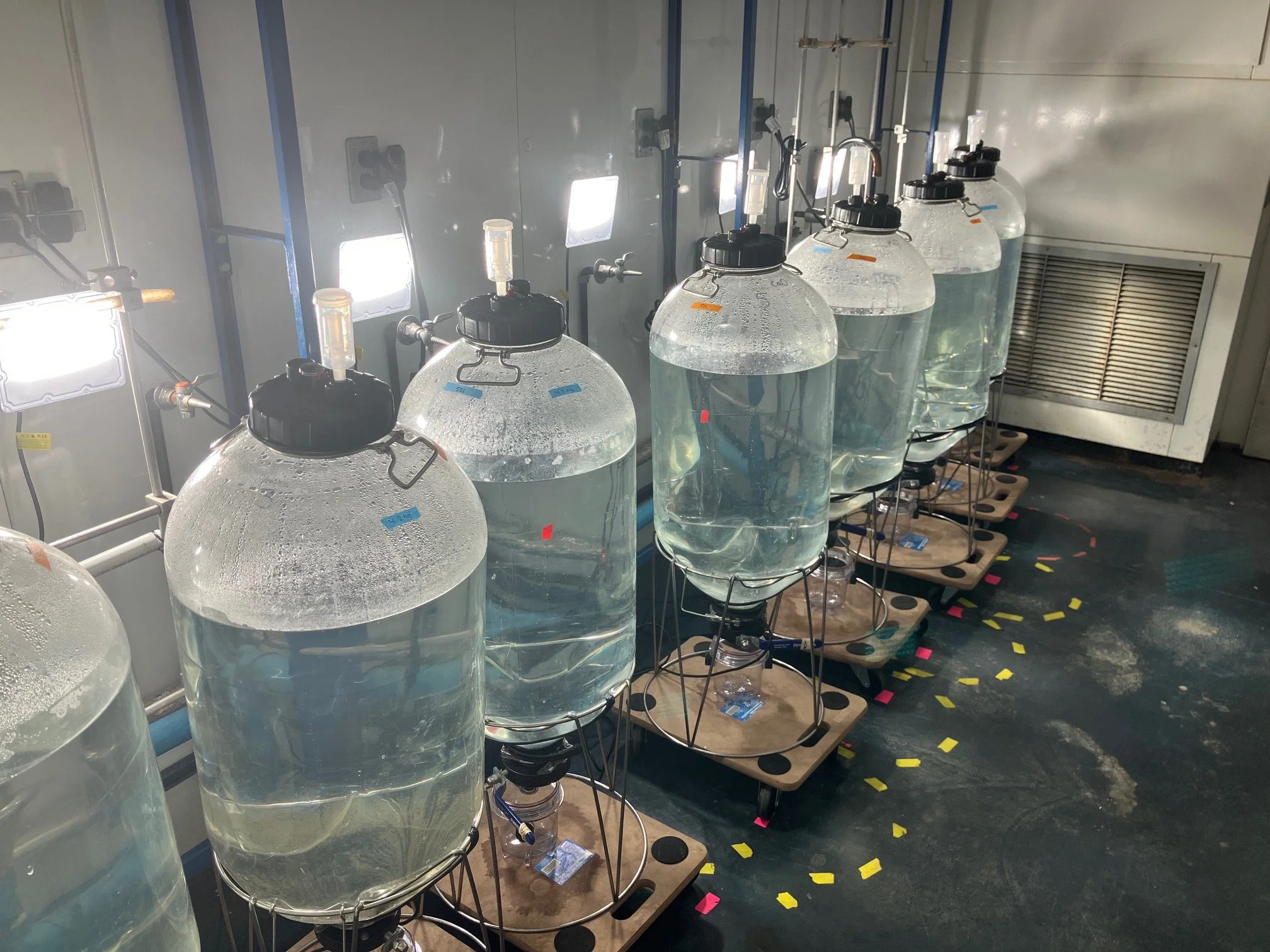
Research samples from the Tufts Cove dosing site. Photo courtesy of Pam Sullivan
LaRoche's lab not only takes samples directly from the dosing site or plume (where the feedstock or mineral is added to the water), and from just outside it, but has also replicated conditions in her lab; applying more variables, including dosing amounts of the Magnesium hydroxide, or feedstock compound, and using varying water temperatures to allow for possible future scenarios with warmer ocean temperatures. When asked about findings, like all researchers, she obviously needs to follow the process of peer review (where the work is presented in writing to colleagues and independent reviewers) but says nothing negative has so far shown up after three years of research data. That aside, she says she knows it's still a new science with unknowns.
“The chemical theory is well understood, but in complex marine environments, however, it’s important to verify and identify whether there are effects that we didn’t know about on the living organisms,” she says.
She adds that emission reduction through transitioning towards renewable, clean energy is essential, but that OAE, if scalable, will also be an important part of the solution.
“Most of the nature-based solutions that have been proposed,” she says, “although important for biodiversity and conservation of habitat, are not going to work because it's too short-term, you know, like mangrove or seagrass meadows. It's the same problem with planting trees; it's just too short term.”
What LaRoche is referring to is the life cycle of trees and other nature-based solutions as compared with CO2 ocean storage.
“The life of the average tree is maximum about 200 years (less in plantations), so too short to have a long-term effect. With the ocean, we're talking in the range of 10,000 or more years,” she says.
But, she adds, it's ultimately going to depend on how quickly we can decarbonize by stopping to burn fossil fuels. As much as we'd all like to believe that there’ll be a quick and easy climate change solution, the reality is it'll be a multi-pronged strategy led by our own ability to wean ourselves from our oil and gas addiction. And in terms of how Laroche feels about the long-term viability of OAE, she says that though initial findings look good, the proof, so to speak, of this particular pudding will be in its scalability.
Planetary has begun evaluating a new calcium-based feedstock, and, not surprisingly, Laroche's lab has already started testing with the new mineral mix. Helping with this research, she says, is her way of doing what she can, in her own way.
“We all need to be fighting. I can't go build offshore wind farms; that's not my domain, so this is how I give back and contribute to solutions.”
This story is part of a special series on marine-based climate solutions that is supported by the Carbon to Sea Initiative, the Marine Environmental Observation, Prediction and Response Network (MEOPAR), and Planetary Technologies.