Getting the ocean bug: Meet Carbon to Sea Canada’s Kohen Bauer
PROFILE: Carbon to Sea Canada’s Senior Manager of Research and Technology lives and breathes all things ocean, and he’s got the tattoos to prove it.
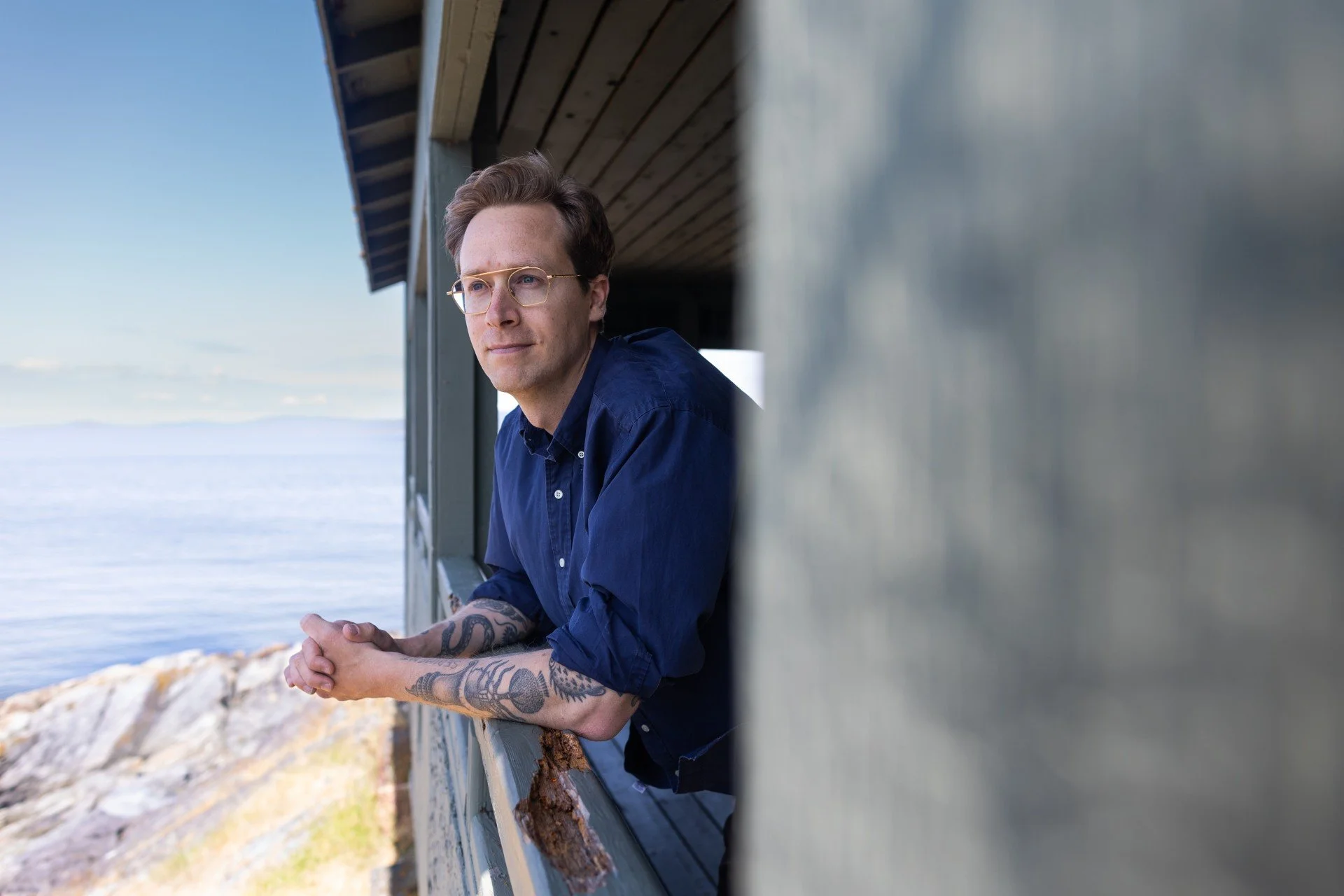
Kohen Bauer. Photo courtesy of Kohen Bauer.
Like many young people, Kohen Bauer headed into his first year of university with little idea of exactly what he wanted to study or what he might do at the end of his undergraduate degree. He knew he was more inclined to pursue something in the sciences but wasn’t sure which discipline would suit him.
It was only in his second semester at Queen’s University in Kingston, Ontario that his path became clear. He was taking an elective called “Natural Hazards” with an eccentric, yet venerated professor who exposed Bauer to the intriguing geology of earthquakes, tsunamis, and volcanos, all in a field unfamiliar to him: Earth sciences.
“I got the bug and was immediately hooked,” says Bauer, now a geochemist and one of the leaders of Carbon to Sea Canada, the Canadian branch of a global initiative aimed at determining whether the ocean can help mitigate the effects of climate change through the removal of carbon dioxide.
“And so that was really just like an ‘aha’ moment. Then, for the rest of my training at Queens, I was in the geology program. Everything started to click. I just loved it,” he says.
Bauer, 37, jumped headlong into the field, moving to British Columbia to work in the mining intelligence space, before heading back to Ontario to do a Master’s degree at the University of Toronto. It was there that his interests got a little more refined, even niche, when he started to learn computer modelling and specifically how you model biogeochemical cycles — including the marine carbon cycle — in the ocean.
“That was my first exposure after taking Earth science and geology and realizing that there's the whole set of comparable processes that take place in the ocean. And that's when I got the ocean bug,” he says from his home in Victoria, B.C., where he lives with his wife and three-year-old field retriever, Lamma.
His fascination with the ocean and its chemical composition led him to Indonesia with his PhD advisor, where they spent weeks at a time doing field work in remote lake systems. As part of the job, Bauer would collect sediment samples to calibrate emerging geochemical tools that help determine how much oxygen is present in seawater, specifically, proxies known as chromium isotopes and iron speciation. He conducted similar work along B.C.’s coast, where he returned to complete his PhD at the University of British Columbia, cruising fjord systems and the Strait of Georgia to essentially understand how the ocean works in past, present, and future scenarios.
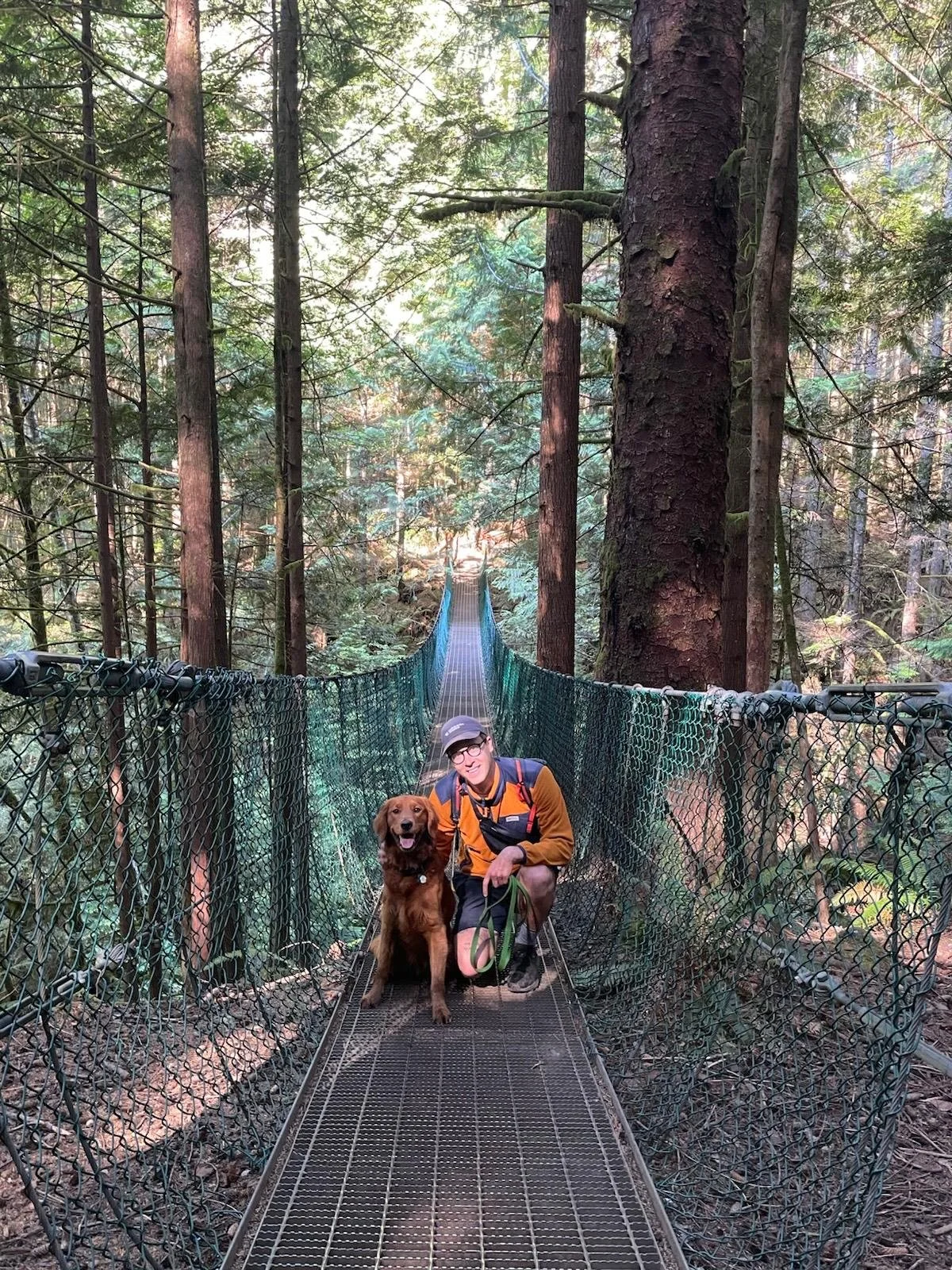
Bauer and gal pal field retriever Lamma. Photo courtesy of Kohen Bauer.
His willingness to go where the science was happening may have been ingrained in him from his parents, and particularly from his famous father. Steve Bauer, one of Canada’s most decorated road cyclists, who moved to Belgium with his wife so he could be closer to competitive events and training opportunities. He did the Tour de France 11 times and won Canada’s first medal for road cycling at the Los Angeles Olympics in 1984.
Kohen was born in Belgium during this period, eventually moving to his parents’ hometown in the Niagara region of Ontario with his younger sister and mom.
To many, his field of study was esoteric, existential, and perhaps without real-world purpose. Questions about geochemical signatures and how they are measured. What was the chemistry of the oceans that formed on Earth eons ago? And how does ocean chemistry evolve and respond to dramatic episodes of climate warming?
But Bauer has taken that seemingly arcane information and is applying it in very real ways with Carbon to Sea.
“What keeps me up at night is I actually think about that stuff, I’m obsessed with thinking about how the ocean can play a role in climate change mitigation,” he says just after returning home from a climate conference in Washington state.
“The question is very applied and that's where I am right now in my life and career. Some of those climate harms are quite existential in nature, but I'm focused on the applied learning. Like, how do we use geochemistry, engineering, oceanography, or systems thinking to make life on Earth better for human beings?”
Bauer describes his role as the group’s Senior Manager of Research and Technology as being its “connective tissue.” He brings together diverse interests working in the field — such as academic, private business, government and other interests — to facilitate research and build robust evidence on the safety, efficacy, and potential scalability of marine carbon dioxide removal (mCDR) and ocean alkalinity enhancement (OAE), including project work in Halifax involving the addition of alkaline materials to coastal outfalls to help water store atmospheric CO₂.
For Bauer, the nascent field is a promising approach to climate change mitigation that Canada is already leading. He sees the work being done by Nova Scotia companies like Planetary Technologies and CarbonRun as being leading edge and globally influential.
“Canada is a global leader in this space. And you can see that with all the momentum that is happening in Nova Scotia with those companies delivering the first independently-verified carbon removal credits related to their respective pathways in the world,” he says.
It’s something that buoys his optimism for the future of climate change mitigation and the potential of these technologies. His enthusiasm for the science has grown throughout his career, borne out by a slew of tattoos on his arms: a rock wearing sunglasses, a geologic timeline of the Mesozoic Era, the mineral calcite and the words ‘scientific progress’ and ‘SEDIMENT,’ the last one a stick-and-poke tattoo given to him by his wife.
“One of the biggest sources of inspiration for me these days is being in a role that uses my training and expertise to enable, inspire, catalyze and support others in the field to do their best work,” he says of Carbon to Sea, which he joined last April. “There's nothing better than that."
This story is part of a special series on marine-based climate solutions that is supported by the Carbon to Sea Initiative, the Marine Environmental Observation, Prediction and Response Network (MEOPAR), and Planetary Technologies.