Prove it
Verifying Ocean Alkalinity Enhancement in Halifax and Beyond.
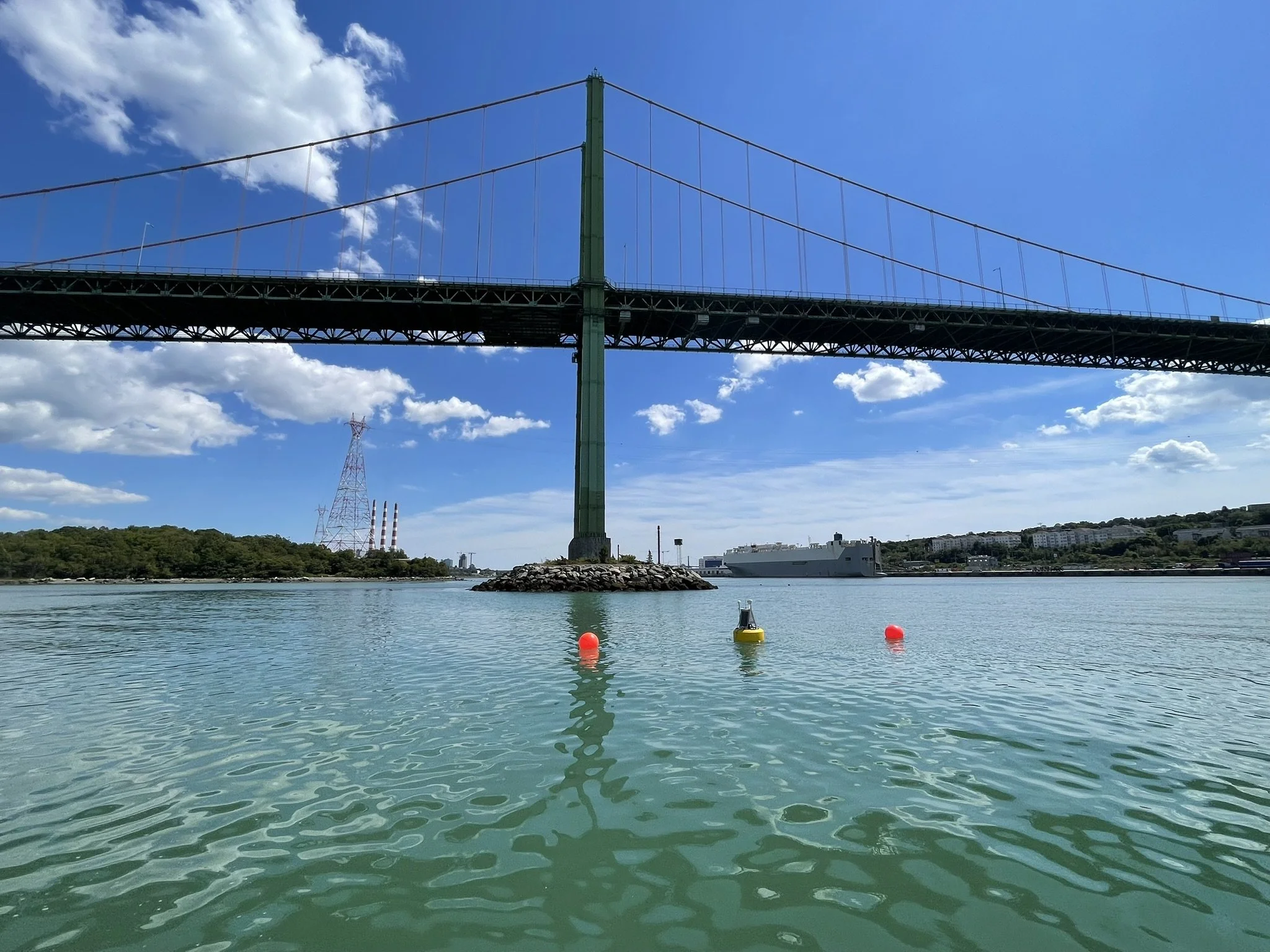
A sensor buoy floating in the heart of “The Narrows” under the MacKay Bridge and just down from the Tufts Cove outflow site. Photo courtesy of Dalhousie University.
Between the cities of Halifax and Dartmouth, Nova Scotia, there flows “The Narrows,” a slim channel of saltwater pouring either northwest into Bedford Basin or southeast into the Atlantic Ocean, depending on the tide.
The channel, which at it’s narrowest point sits just under the A. Murray Mackay Bridge, in length, spans the distance between the MacKay Bridge and the older MacDonald Bridge further south. It is flanked by Halifax Shipyard to the south and the Tufts Cove Generation Station to the north. Both significant sources of CO2
But The Narrows, with the help of a local carbon removal company, diligently soaks this carbon up, snatching molecules from local tailpipes and smokestacks, hauling them beneath the waves, there to join a chemical dance for the next thousand years or so, safely removed from a warming climate.
The company working to help it absorb additional CO2 is Planetary Technologies, a climate mitigation startup which has, since 2023, mixed finely ground magnesium oxide into the outfall site of Tufts Cove, a natural-gas powered electricity plant, before eventually entering harbour waters in a bid to increase its overall alkalinity. More alkalinity means more carbon can join the chemical dance beneath the waves. The process is called Ocean Alkalinity Enhancement (OAE),
An Interesting Problem
Dariia Atamanchuk, a chemical oceanographer with Dalhousie University, didn’t start her career with OAE. She started in climate change, studying where, when, and at what rate our oceans were exchanging oxygen and carbon dioxide with the atmosphere, and what that meant for a warming world.
“For a long time, we were researching the problem,” says Atamanchuk. “OAE gave us the opportunity to research the solution.”
Atamanchuk is a founding member of Ocean Alk-Align, an international research project (actually several small projects) studying different aspects of OAE: safety, scaling, sourcing, etcetera, in labs or in outdoor microcosm experiments, its researchers meeting online twice a month to discuss their findings, or collaborating directly. Atamanchuk was drawn to one of the simplest questions in OAE, and one of the slipperiest: does the chemistry work as advertised, and if so, how do you prove it?
“The chemistry of OAE is well understood,” she says. “It’s like math — difficult to argue.”
But our oceans are a chemical quagmire in which the signature of OAE is difficult to detect, let alone interpret. Nowhere is this truer than in coastal cities with their waters receiving, as they do, a lot more from humanity than magnesium oxide. But this is where Planetary Technologies operates, and since no one else has ramped up OAE at the same scale, Atamanchuk says this is simply the best opportunity for her to conduct this kind of research.
The Robots
A chemical oceanographer cannot neglect her tools. Fieldwork will always be necessary, says Atamanchuk, but continuous measurements of an ocean’s behaviour in every season, and in all conditions, is hard on human beings. Autonomous platforms, loaded with sensors, are as critical in The Narrows as they were in the Labrador Sea, where she spent much of her early career.
“I’m a big believer in fit-for-purpose,” she says. “You cannot just use the same equipment over again in a different environment.”
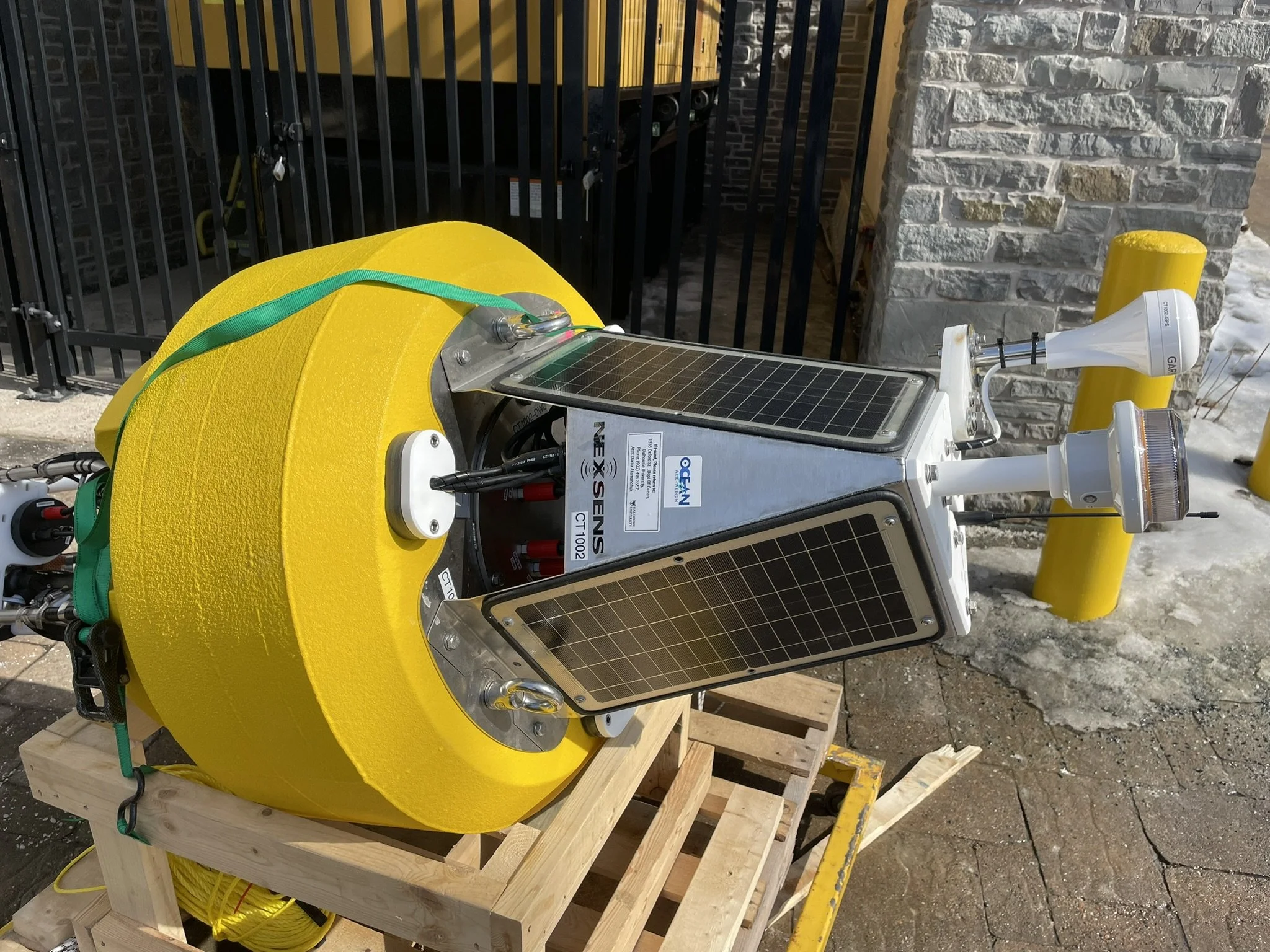
A specially designed buoy, retrofitted to carry extra sensors. Photo courtesy of Dalhousie University.
For The Narrows, fieldwork was supplemented by two autonomous buoys, built by the American company NexSens, and retrofitted by a postdoctoral fellow to carry extra sensors (particle density, pH, PCO2, etcetera). One buoy was anchored upstream of Planetary’s dosing site — the outflow of the Tufts Cove Generation Station, where they mix in the magnesium oxide — and the other buoy downstream. Chugging between them was the “BlueBoat,” an unmanned catamaran built by Blue Robotics, also American, also loaded with sensors.
Direct measurements of Planetary’s magnesium oxide plume in The Narrows, while critical, weren’t enough to demonstrate efficacy, says Atamanchuk. Total alkalinity is difficult to pin down when water’s on the move, and total alkalinity wasn’t the number she needed anyway. The total increase in alkalinity is what matters for OAE.
Thankfully, Atamanchuk was thinking ahead. In the years before Planetary got started, she and her team dedicated themselves, not to The Narrows, but to the Bedford Basin, using sporadic grants to learn its chemical baseline, and how this baseline swung with inputs from the Atlantic Ocean downstream, the Sackville River upstream, and the wastewater treatment plants dotting the shore. How much change could be expected by the year, or by the day? What happened during record snowfall, or record drought? It was against this chemical profile they would eventually measure the addition of magnesium oxide downstream.
“The Bedford Basin represents a really great research opportunity,” says Atamanchuk, “because it doesn’t get immediately flushed out. Water stays in the Basin and accumulates the signal a bit.”
And this is exactly what happened. When Planetary doses The Narrows, Atamanchuk’s buoys and BlueBoat — afloat and in action since 2025 — follow the chemical signature as far as the MacKay or MacDonald bridge, after which point it’s essentially undetectable. This is a good thing, says Atamanchuk, because it suggests the magnesium oxide is dissolving as planned, and flushing as planned.
But increases in alkalinity couldn’t be quantified downstream, when a receding tide flushed The Narrows into the Atlantic Ocean. But when the tide came in, and Planetary’s chemical signature was pushed upstream into the Bedford Basin, it lingered long enough for Atamanchuk and her team to measure it against their baseline data. Sure enough, alkalinity was increasing as expected.
“The chemistry works,” says Atamanchuk.
The Science of Affordability
Atamanchuk’s data — from the Bedford Basin and The Narrows — have been input into a computer model developed by Dalhousie University colleague, Katja Fennel; a model designed to calculate how much alkalinity is being gained overall, upstream and down, as well as the general location of where that alkalinity is pulling carbon out of the atmosphere, namely, the Bedford Basin or just outside the Harbour, along the coast. These calculations come with a healthy margin of error, but as more data roll in, down the margin goes.
The model, however, is specific to the waters off Halifax, says Atamanchuk — more specifically to the magnesium oxide treatments by Planetary. Apply OAE to different waters, and baseline research and continuous monitoring must begin anew. Some of their findings will no doubt be transferable to other projects, she says, but there is no substitute for a thorough, hard-won understanding of the waters one intends to dose. Without it, the margin of error is just too high.
“People have been asking how we can scale up the knowledge gained here,” says Atamanchuk, “without wasting two years collecting baseline data elsewhere, and my answer is that there’s just no way around it.”
That said, the tools developed in The Narrows – in particular the buoys and BlueBoat – are very transferable to other projects, which, like Planetary, will need to prove their OAE is safe and effective if they plan to sell carbon credits. Atamanchuk hopes to spend more of her time perfecting their remote sensing equipment, so it might be ready and affordable for the regulatory agencies policing OAE projects in the future.
“Our equipment has always been about the science,” she said. “Now we have to make it produce good science while also being cost effective.”
This story is part of a special series on marine-based climate solutions that is supported by the Carbon to Sea Initiative, the Marine Environmental Observation, Prediction and Response Network (MEOPAR), and Planetary Technologies.