Scattering light
Sequoia Scientific’s laser sensors help monitor ocean alkalinity enhancement efforts.
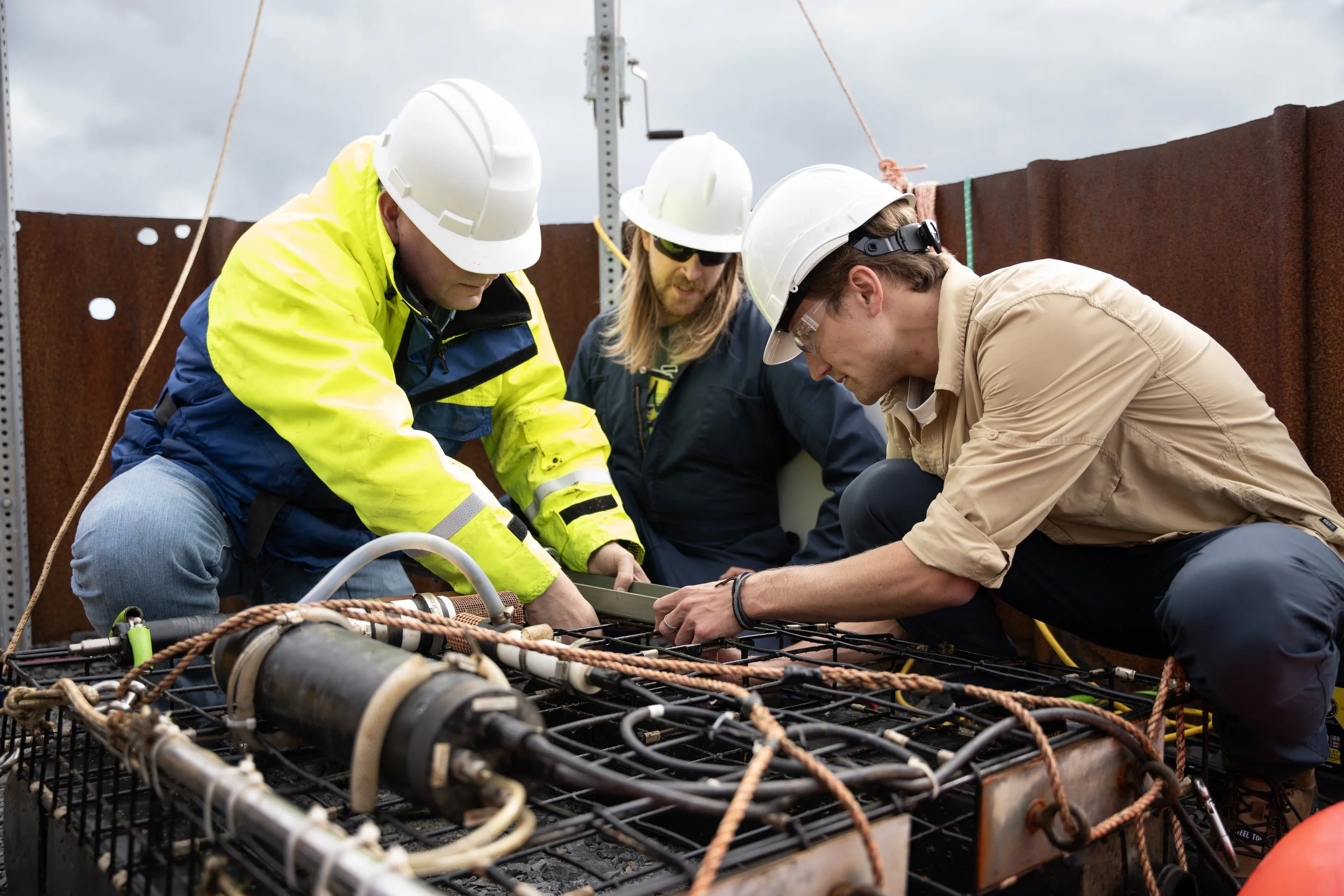
Sequoia CEO, Ole Mikkelsen (left) and Kirby SImon (right) installing a sensor in Halifax Harbour, in September 2024. Photo by Darren Calabrese for Carbon to Sea.
A company based near Seattle makes sensors that measure particles in the ocean. On the other side of the continent, a Halifax-based company is introducing particles into the marine environment in hopes of combating climate change.
It seemed like these two should meet.
All it took was a LinkedIn post to bring them together.
The American company is Sequoia Scientific, developers of the LISST (Laser In Situ Scattering and Transmissometry) sensors. The Canadians are Planetary Technologies, one of the outfits at the forefront of research into Ocean Alkalinity Enhancement (OAE) — a technique aimed at drawing carbon dioxide from the atmosphere into the ocean, by introducing minerals that increase alkalinity.
Planetary is a partner in a program funding OAE research called the Joint Learning Opportunity, and that’s how Sequoia learned about them.
“I came across the funding opportunity on LinkedIn — actually someone had reposted it,” says Kirby Simon, Sequoia’s science and technology lead. “I'd never heard of [the] Carbon to Sea [Initiative] before. I didn't know about Planetary Technologies. I didn't know about the field trial going on up there [in Halifax]. There were specific areas of interest they were hoping to fund, and one of them was related to particle dissolution and precipitation, and environmental impacts...We're a particle size company and we can measure things in the water in real time, without needing a sample. It just felt like a natural opportunity.”
From kayaking and snorkelling, to building undersea sensors
The Sequoia product line includes a number of submersible sensors that use laser scattering to determine the size and concentration of particles in the water.
The company’s story starts in 1995, with the invention of the first LISST sensors. (They make about a dozen different ones now, with more in development.) The company was co-founded by Yogesh Agrawal, who everyone seems to just call Yogi, and Chuck Pottsmith. Read the bios of Sequoia staff, and a strong oceans theme emerges quickly: from Yogi’s oceanography studies, to Pottsmith’s love of sea kayaking.
Sequoia president and CEO Ole Mikkelsen, who joined the company nearly 20 years ago, and stepped into his current role in 2019, says, “We've always been focused on the ocean science industry but we're just doing that more. There is an obvious need for the instruments that we build in ocean science.”
When Simon came to him with the Joint Learning Opportunity idea, it seemed like a perfect fit.

Sequoia Science and Technology lead, Kirby Simon. Photo Courtesy of Kirby Simon.
Simon, whose background is in chemistry and material science, “grew up all over the place” and did graduate studies in landlocked St. Louis, but says oceans have always been one of his passions. He remembers snorkelling in his youth, being “mesmerized, and thinking if I could do something in the ocean field some day, it would be pretty exciting.” He was “drawn more to the nature and ecology side of things,” but after getting degrees in chemical engineering and material science, decided he could “come at the ocean from more of an engineering perspective,” and use what he'd already learned, applying it to something he was “passionate about.”
After unsuccessfully trying to get funding for a startup, and wanting to pursue his passion for oceans, he sent a job-hunting email to Sequoia “out of the blue.” Turns out the previous VP of Science and Technology had just left the company. Simon was hired and started to work there in January 2024.
Like headlights in the fog
One of Sequoia’s trademark technologies — as previously mentioned — is a sensor that “uses laser scattering to measure particle size and particle concentration in the water,” Simon explains.
“Think of shining your headlights into fog, and you see all the light scattering,” he says. “The unit shines a laser through the water, and if there are particles in the water — sand, sediment, plankton, microplastics, anything like that — when the laser beam hits them, they’re going to scatter light in all sorts of directions.”
The sensors have an array of 32 tiny detectors (“cameras, essentially”) that measure the intensity and the angle of the scattering. Based on that information, the company can calculate the size and concentration of the particles.
Planetary Technologies has been running their project at Tufts Cove in Halifax harbour — that’s the field trial Simon was referring to — adding what he refers to as “crushed up alkaline material” (magnesium hydroxide) to seawater near the outflow of a power plant. The idea is to “create a void of carbon dioxide in the water,” which then pulls in CO2 from the atmosphere, sequestering it in the ocean.
One of the key factors in determining whether their approach will work on a larger scale is understanding how the particles being added to the water behave.
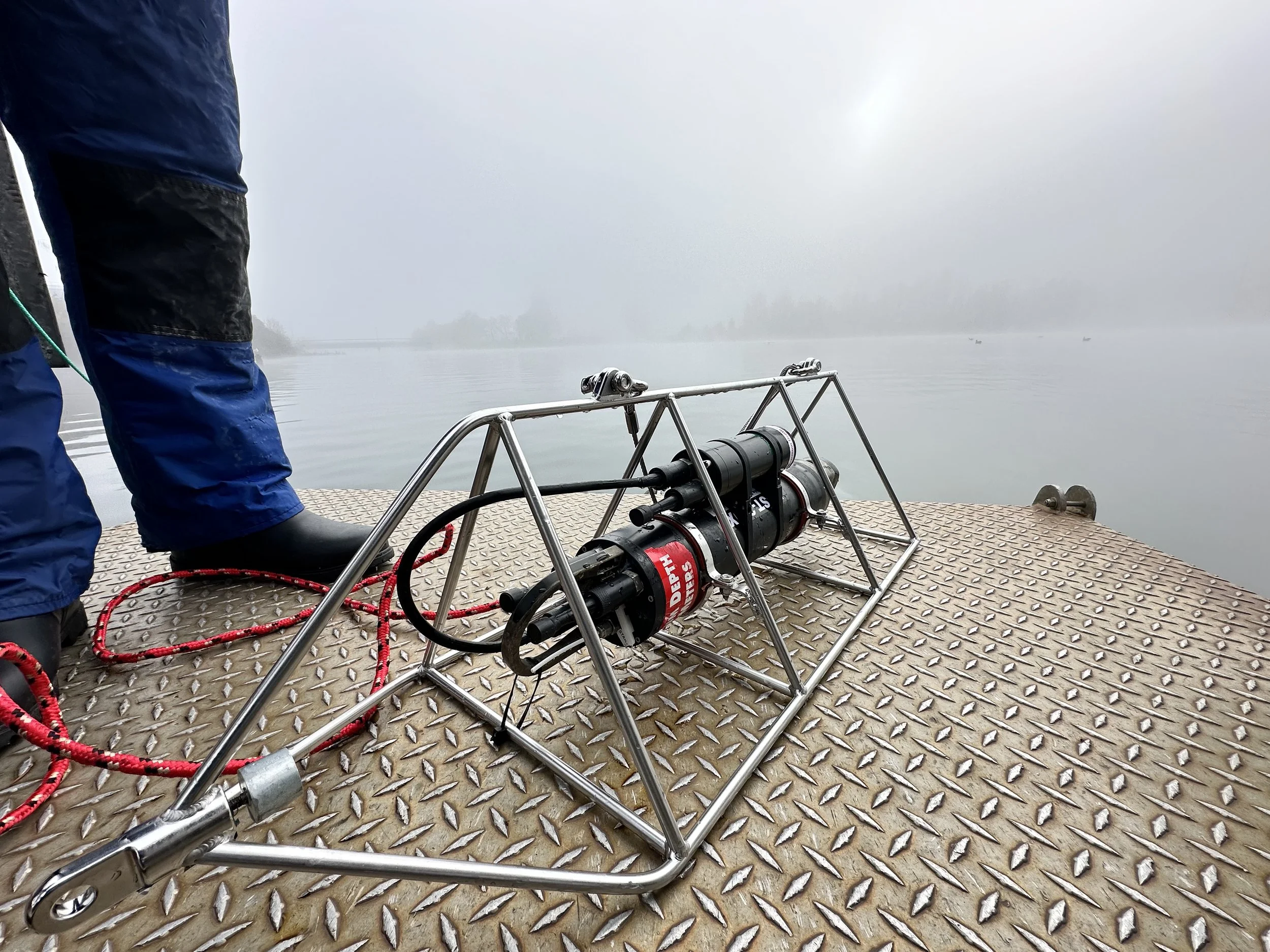
A LISST 200X ready for deployment into the Halifax Harbour. Photo courtesy of Sequoia Scientific.
Enter the Sequoia sensors, which were installed in September 2024, and stayed in the water until spring 2025.
The company deployed four different sensors: two LISST-200X units, as well as a couple that measure optical transmission in the water, indicating how turbid it is, and how much material is present.
To gauge the effectiveness of nascent OAE systems, it’s important to understand how the particles added to the water are behaving, Simon says — and that’s something Sequoia’s sensors can measure in real time.
“As a particle in the water is dissolving, it's getting smaller and smaller and smaller. Our sensors can measure the particle size, so we see that signature changing over time as they are dissolving,” Simon says.
The results can provide data to complement Planetary’s other monitoring.
In an interview published by Carbon to Sea in January 2025, Simon was quoted as saying, “There is also a need to understand potential environmental impacts such as secondary precipitation, to determine if OAE can be a scalable climate solution.”
Asked to elaborate, he says, “The precipitation point is important. But on top of that, even if there isn't precipitation, our particles may be settling to the seafloor and not actually dissolving, or are being transported away to locations where the conditions aren't as favourable, and dissolving slower. The behaviour of the particles, and understanding what's happening to these particles in the water, has critical implications to the effectiveness of a treatment.”
Bubbles, bubbles, toil and trouble
While the case for using the Sequoia sensors at the Tufts Cove project site seems clear, deploying them was not without challenges.
In addition to detecting particles, the LISST sensors also detect bubbles — and the water by the power plant outflow was turbulent and full of bubbles. Bubbles that scatter light, just as particles do.
The solution Simon and his team came up with was to drop the sensors down lower into the water. Fortunately, Planetary already had some sensors “deployed on a cage system of sorts” several metres below the water, attached to buoys at the surface, where there were far fewer bubbles.
“Essentially, we could mount our instrument on the bottom of that cage,” Simon says. “You would still see some scattering from bubbles in the data, but once we were low enough below the surface you could definitely see differences between the background water, when there was no material being added. And when they were adding the material, you could see very small signatures of the material in the water. But it took some playing around to get to that point.”
But not all the tests were a success.
Sequoia president and CEO Ole Mikkelsen says, “We had a sensor that was supposed to measure the flux of the particles —how fast they're settling out, and how many grams per square metre they're settling per day. And that just didn't work in these environments, because it was way too turbulent.”
But that failure doesn’t trouble Mikkelsen. He says it’s all part of doing basic research.
“We can use this to propose better ideas in the future, and probably use the data to inform better monitoring going forward in other field trials too,” he says. “Overall, it was a very positive experience.”
This story is part of a special series on marine-based climate solutions that is supported by the Carbon to Sea Initiative, the Marine Environmental Observation, Prediction and Response Network (MEOPAR), and Planetary Technologies.