The eyes have it
Indigenous involvement in Ocean Alkalinity Enhancement could be a practical example of Two-Eyed Seeing.

Commissioned Indigenous artwork depicting Planetary’s project at the Nova Scotia Power facility in Tufts Cove. Graphic courtesy of Planetary Technologies.
“I admit I was a bit nervous because we were presenting right in front of Doctor Albert Marshall, the father of two-eyed seeing,” says Eric Christmas, a longtime Mi’kmaw consultant who has worked on projects ranging from clean energy to affordable housing to, more recently, ocean-based carbon removal.
The concept of Two-Eyed Seeing (Etuaptmumk in Mi’kmaw), according to Mi’kmaw Elder Marshall, aims to view the natural world through one eye with the strengths of Indigenous ways of knowing, and through the other with the strengths of Western ways of knowing.
Christmas, the Senior Advisor on Indigenous Affairs for Planetary Technologies, along with the Planetary team, was presenting at The Collaborative Environmental Planning Initiative (CEPI) community meeting in Eskasoni on the coastal Ocean Alkalinity Enhancement (OAE) work of the Dartmouth, Nova Scotia-headquartered company.
Dr. Marshall, who developed the Two-Eyed Seeing methodology alongside Traditional Knowledge expert Murdena Marshall and biologist Cheryl Bartlett, listened carefully as Christmas talked about how Mi’kmaq communities can get involved in this burgeoning sector, and why Indigenous knowledge is critical to ensuring marine carbon dioxide removal keeps environmental and community protection front of mind.
After the presentation finished, all eyes turned to Dr. Marshall. “It was a relief,” says Christmas, “when his first comment was that this was one of the best examples he had seen of how two-eyed seeing should be applied.”
“That gave us a great deal of confidence for our ongoing engagement work,” adds Christmas, a member of Planetary’s Two-Eyed Seeing Committee for coastal OAE, bringing Indigenous knowledge and Western science into governance and practice.
“Learning from Indigenous Nations, and having them guide our projects, has been foundational to our work, says Diana Philip, VP of Community Relations at Planetary. “Those relationships begin early and continue throughout development, with their knowledge, questions, and priorities informing our design and monitoring.”
Planetary Technologies is helping restore the ocean’s natural ability to absorb carbon dioxide from the atmosphere and store it safely in the sea for thousands of years. The company adds natural, purified alkaline minerals to seawater, which combine with atmospheric CO₂ to form stable bicarbonate and carbonate ions.
Aquatic organisms can use these ions to form shells. Unused bicarbonate remains dissolved in the water for thousands of years, slowly transported into the deep ocean through natural circulation.
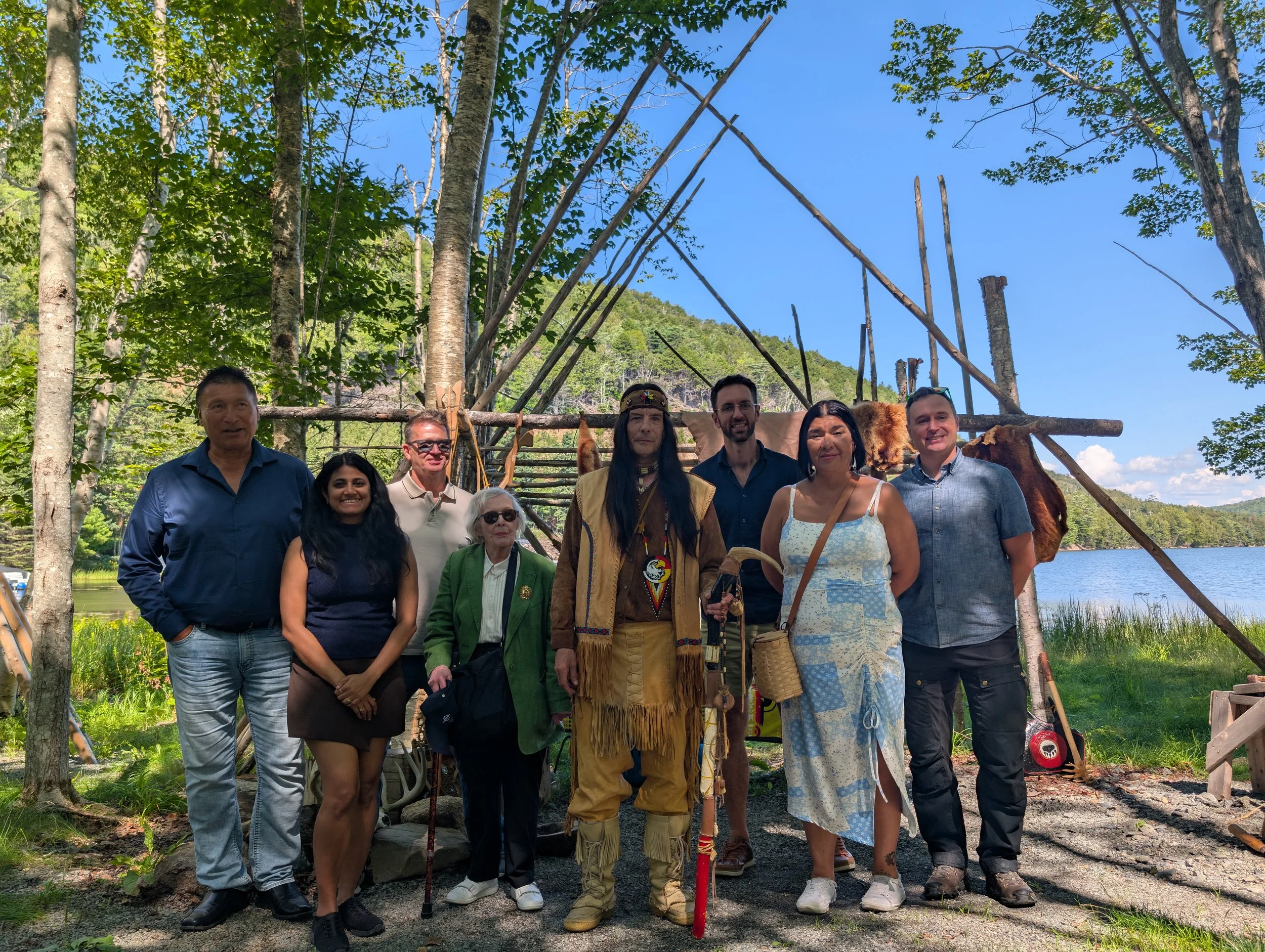
Two-Eyed Seeing committee group pictured in Eskasoni. Photo courtesy of Planetary Technologies.
The climate-ocean connection
The ocean absorbs around one-quarter of the carbon dioxide produced by human activities each year. But the mixture of water and CO₂ creates carbonic acid, which threatens coral reefs and aquatic species, including mollusks (clams, mussels, snails) and crustaceans (lobsters, crabs, shrimp).
As greenhouse gas emissions rise, our oceans become increasingly acidic as the carbon-ocean balance is thrown off-kilter. “But by adding alkalinity to the ocean, you soak up some of the CO₂ in the water,” explains Burt. “Then that creates what I describe as a vacuum, where you've got less carbon in the surface water than you did before, and so the CO₂ from the air moves in to fill the void. And if we can keep enough alkalinity in the ocean, we’re helping the natural process of moving carbon from the sky to the sea.”
We need to reduce greenhouse gases — and quickly — but at this point it’s not enough. The Intergovernmental Panel on Climate Change (IPCC) has acknowledged that emissions reductions alone won't meet our climate targets, and carbon dioxide removal will be needed to offset emissions.
Local action, global leadership
Nova Scotia, which sits within the broader Mi’kma’ki region, has become a global leader in efforts to reduce acidification of rivers and oceans while safely absorbing carbon from the sky.
The province is home to several leading marine carbon dioxide removal (mCDR) companies, including Planetary and a similar social purpose business, CarbonRun, which works to restore a river's natural ability to carry carbon to the sea for long-term storage. That company also helps bring back declining fish populations, including Atlantic salmon.
Both Planetary and CarbonRun recognize the importance of involving Mi’kmaq communities in carbon removal, and of learning more about their perspectives on the natural world.
“Rivers are the lifeblood of many Indigenous communities,” says Dr. Eddie Halfyard, a freshwater ecologist and co-founder of CarbonRun. “One reason we chose the location of our first project was that it was near Pictou Landing First Nation, which has shown strong leadership in sustainability. We’ve developed a really good relationship with the Nation.”
Planetary’s Two-Eyed Seeing process builds on years of engagement with Indigenous Nations and communities. That work spans ongoing dialogue with leaders and Elders, community partnerships, cultural awareness trainings, and bringing Indigenous perspectives into project design and monitoring. Planetary has also ensured Indigenous research is part of their ‘Joint Learning Opportunity,’ a collaboration with Carbon to Sea and MEOPAR that funds research on OAE. One project focuses on integrating First Nations knowledge and concerns into monitoring water-based carbon removal, a partnership of Lennox Island First Nation, the Mi’kmaq Confederacy of PEI, and the research organization ONDA.
“Lennox Island operates an oyster farm,” says David Stirling, the Director of Integrated Resource Management for the Mi'kmaq Confederacy of PEI, “and there’s some research showing a benefit to shell growth using OAE methods — putting calcium or magnesium into the water bolsters the shells. But we need the data to show there is no negative impact, and First Nations can help get that data.”
When Lennox Island first surveyed community members about ocean alkalinity enhancement, the response was hopeful but not unconditional.
“There was a high level of support for looking into OAE as a pathway [for climate action],” Stirling says. “But people also wanted to make sure any potential impacts on the big industry there, the fisheries, are being investigated.”

Planetary CEO, Mike Kelland, with a member of the Confederacy of Mainland Mi’Kmaq (CMM) Indigenous Organization - representing eight first nations communities in Nova Scotia. Photo courtesy of Planetary Technologies.
Lots of fish (diversity) in the sea
For Ken Paul of Pokiok Associates, based in the Wolastoqey Nation at Neqotkuk, New Brunswick, that concern is critical. The fisheries industry has deep economic importance and cultural resonance to Indigenous communities and the broader Atlantic region.
“No country, no nation-state, has clear regulations around OAE and the fisheries,” says Paul.
Paul has decades of experience in the ocean economy, including stints as the lead fisheries negotiator for Wolastoqey First Nation and the Director of Fisheries at the Assembly of First Nations. He has become a strong voice in the OAE world, weaving Indigenous knowledge into the growing carbon removal space.
“There is important research being done on the water chemistry, and it’s being done by a lot of smart people. We need it,” he says. “But we also need to look at the impacts of alkalinity additions on specific species of fish in situ. How do the substances we add impact, say, American eels in one location versus another species in another? How is one unique ecosystem different from that one? Ocean carbon removal is about the macro, the big picture, but it’s also about very local habitats and about how a community uses the waters.”
At Planetary’s Tufts Cove site, that local focus is already part of the work. Ecosystem monitoring and research extend beyond water chemistry to include plankton communities, bivalve responses and seafloor ecosystems. Its feedstock has also undergone ecotoxicity testing on eight different marine organisms, including fish, bivalve embryos, and lobster larvae.
“We added lobster larvae testing in direct response to feedback from the fisheries community in Nova Scotia,” says Philip.
Indigenous knowledge systems
Paul says Indigenous communities must be involved at the outset.
“They may have the knowledge that leads to different local carbon solutions. This approach would be best for here, or some combination of approaches that complement OAE, such as using macroalgae,” he says.
As ocean-based carbon dioxide removal scales up from pilot projects, its footprint will overlap with fishing grounds and traditional territories.
“Indigenous communities must be part of the early co-design,” says Paul. “They will be very sensitive to seeing changes in the environment, because they have the base knowledge of what's there now and what was there at one time.”
His work in the OAE space has led Paul to caution that when it comes to Two-Eyed Seeing, we may not be seeing clearly enough.
“The beauty of the concept is that people can understand it right away: you're advancing two different knowledge paradigms. But I don't always call it Indigenous knowledge; I prefer to call it an Indigenous knowledge system,” he says. "What people sometimes miss is the integrative part, that you're actually going to have areas of disagreement, and you have to spend a lot of time at the outset to figure that out. In the end, you’ll develop a methodology which will be unique to a local environment.”
Carbon removal as reconciliation
David Stirling, from the Mi'kmaq Confederacy of PEI, agrees that while the term Two-Eyed Seeing is used a lot in presentations, “you don’t always see it in practice.” He believes water-based CDR can be different.
“It’s a new sector, and there’s a true opening to build in the collaboration from the start rather than bolt it on after.”
For Eric Christmas, there is economic opportunity as well as environmental gain. Indigenous communities in Atlantic Canada haven’t always received enough benefit from clean-energy credits: wind power credits, for example, flow to utilities, not to the Nations that may be hosting the turbines. Carbon removal, however, works differently since the credits can be sold directly on global markets.
“If we can create a real movement in First Nations to look at carbon removal credits as a way to get involved,” says Christmas, “to create and lead a wholly Indigenous-owned CDR project…well, that is true economic reconciliation.”
This story is part of a special series on marine-based climate solutions that is supported by the Carbon to Sea Initiative, the Marine Environmental Observation, Prediction and Response Network (MEOPAR), and Planetary Technologies.