MARCH 2026 UPDATE:
A quick update on how things have been going with the Building to Zero Exchange since we last spoke for the 2023 article below.
Since its fall 2023 opening, the Building to Zero Exchange – which falls under the organizational umbrella of Net Zero Atlantic – has been a going and growing concern. Director Taylor Owen says partnerships — including with the province — and working with industry, is helping to move the needle towards the province’s 2030 greenhouse gas emissions reduction target.
“We’ve been doing a lot of work to be ready to adopt the building code and the higher energy tiers that are coming,” Owen says.
In April, builders will still build to the 2020 NBC and NECB, but to Tier 2 of the NBC, which has higher energy efficiency requirements. In terms of change, this second tier, she says, will be a stronger move in the right direction.
“The first tier wasn’t a big change, especially in terms of the energy requirements,” she says. “Taking a closer look, you can see what’s coming in terms of tier 2 and 3, so gives the industry a bit of a preview.”
April’s second tier application of the NBC will apply to single family homes and smaller buildings, requiring them to comply with 10 per cent higher energy efficiencies.
Larger developments will fall under the NECB, with stricter energy requirements coming into place in 2027. And in terms of Halifax construction, which is currently experiencing a rapid boom, Owen says there are a few factors at play.
“I think there’s always a bit of a push to get your permit before the date of a change, but I’d say a lot of what we’re seeing in terms of development is around trying to deal with the housing crisis.”
The bulk of the organization’s work is around training and education, with an early win, says Owen, being their work with the Nova Scotia Building Officials Association, to implement training on the upcoming requirements within the code.
“We provided that training to every building official within the province so that was a pretty big lift,” she says. “And I think that’s given our industry a lot of confidence that the people who are inspecting the buildings for code compliance and enforcement have the knowledge and process to now be able to do that.”
And with respect to numbers, things are moving at a good pace, with stats from Net Zero Atlantic’s 2024-25 Annual Report painting a positive picture. From 2023-25 Building to Zero Exchange produced 22 reports, 11 projects, hosted 134 contributors, hosted 33 presentations, and held five events with a total of 226 registrants.
In terms of those big developers who the city needs to get onboard with efficiencies, Owen says they’ve been at the table and interested in learning about how to best comply with upcoming code changes.
“We had an industry roundtable a while back, and had the province at the table, and we heard about their challenges and where they need support, but also that people are ready and just need clarity on what they need to do. We’re ready to do it was the overwhelming message,” she says.
Challenges, she says, are likely familiar to most in the construction industry; primarily centred around workforce issues and a lack of skilled workforce with a knowledge of greener building processes.
“I think it’s beyond just green buildings. It’s really, you know, our industry. We have a lot of people retiring, and a lot of demographic changes that we need to be aware of and make sure we have a plan for moving forward,” she says.
Looking at the future of the exchange, Owen says she’s hopeful and optimistic based on the interest she’s seen, often from unexpected groups.
“I think our magic is bringing people together who don’t often get to be in the same room, and allowing them to work on problems together, to collaboratively solve things.”
- Pam Sullivan
A new Building to Zero Exchange is helping the construction industry in Nova Scotia lower the carbon footprints of our homes – and help achieve our climate targets.

Lara Ryan, Senior Advisor to the Building to Zero Exchange, in a home undergoing energy efficiency retrofits. Photo by Sean Kelly.
Build it and they will come, the saying goes. But who is going to build it? And who’s going to build it green?
Those are the questions a new Nova Scotian collaboration plans to answer. The Building to Zero Exchange (BTZx) is dedicated to growing capacity that supports construction of high-performance, green buildings.
“We have to build better buildings. That’s why we created BTZx, a networking model that brings folks who are working on greener buildings together, to learn from each other, and to collaborate,” says Lara Ryan, senior advisor of the Exchange, and one of the catalysts of its creation.

Inside a home undergoing deep energy efficiency retrofits. Photo by Sean Kelly.
BTZx will help cut greenhouse gas (GHG) emissions in the province – Nova Scotia’s goals are to reduce GHGs by at least 53 per cent below 2005 levels by 2030 and is to attain net-zero status by 2050 – by ensuring more of our buildings are energy net zero going forward. A net zero building is one that generates as much energy as it uses, so it has an energy use balance of zero.
“Building high-performance buildings, net zero homes, and net zero commercial and institutional buildings… this is the vision,” says Ryan. “There’s lots of great work being done, but we’re not always connecting the dots and making sure we’re learning from each other and finding opportunities to collaborate.”
Reducing GHG emissions is key to mitigating the worst impacts of climate change.
“Climate action is urgently needed,” says Shannon Miedema, Director of Environment and Climate Change for the Halifax Regional Municipality. In 2020, the Halifax Regional Council unanimously adopted HalifACT, the city’s ambitious plan to achieve net-zero by 2050.
It’s a commitment to reduce emissions, switch to clean energy sources, and show that leadership can come from local governments. HRM is a foundational partner of the Building to Net Zero Exchange, along with the Province of Nova Scotia, Dalhousie University, Efficiency Nova Scotia, Clean Foundation, the Construction Association, and the Nova Scotia Community College.
Net Zero Atlantic is serving as the secretariat for the broader network, which includes building designers and contractors, policymakers at various levels of government, building owners, and the many other stakeholders in the business of reducing our carbon footprint.
“We need an intentional effort to build more green buildings in Nova Scotia,” says Miedema. “I think there are a lot of contractors ready and able to build high performance buildings. But we need to support this green building sector with the right policies, procedures, and knowledge. So many people are talking about this, but we just have to do it. And now.”
You need only look out your window to see there’s a building boom across Nova Scotia, and a need for more housing. Statistics Canada shows that Nova Scotia’s population rose by over 30,000 this year, and Halifax will soon break the 500,000 people barrier. The provincial government has said it wants to see the province’s population hit two million by 2060.
“I’m concerned that all the housing being built right now is locking us into a carbon future,” adds Miedema. “But at the municipal level, Halifax can’t legislate that all new buildings be net-zero ready. We need the province to support a different future.”
Halifax Mayor Mike Savage agrees that the climate crisis must be a lens applied to new infrastructure and construction.
“Action was best 30 years ago, but now is the only time we have,” Mayor Savage said at the launch of the Building to Net Zero Exchange. “Halifax is not too small to take action – that’s why we created HalifACT.”
Fortunately, better building codes are on their way in Canada. By 2030 new buildings must be highly energy efficient and net-zero ready. But until then, construction doesn’t have to meet these higher standards.
“If we’re going to build 40,000 new homes in the next few years, we need to make sure they are high energy efficiency buildings – they are going to be here for 75 years or more,” says Ryan. “The Building to Net Zero Exchange wants everyone to know that we already have the technology, and that reducing energy is good economics over the lifetime of a building.”
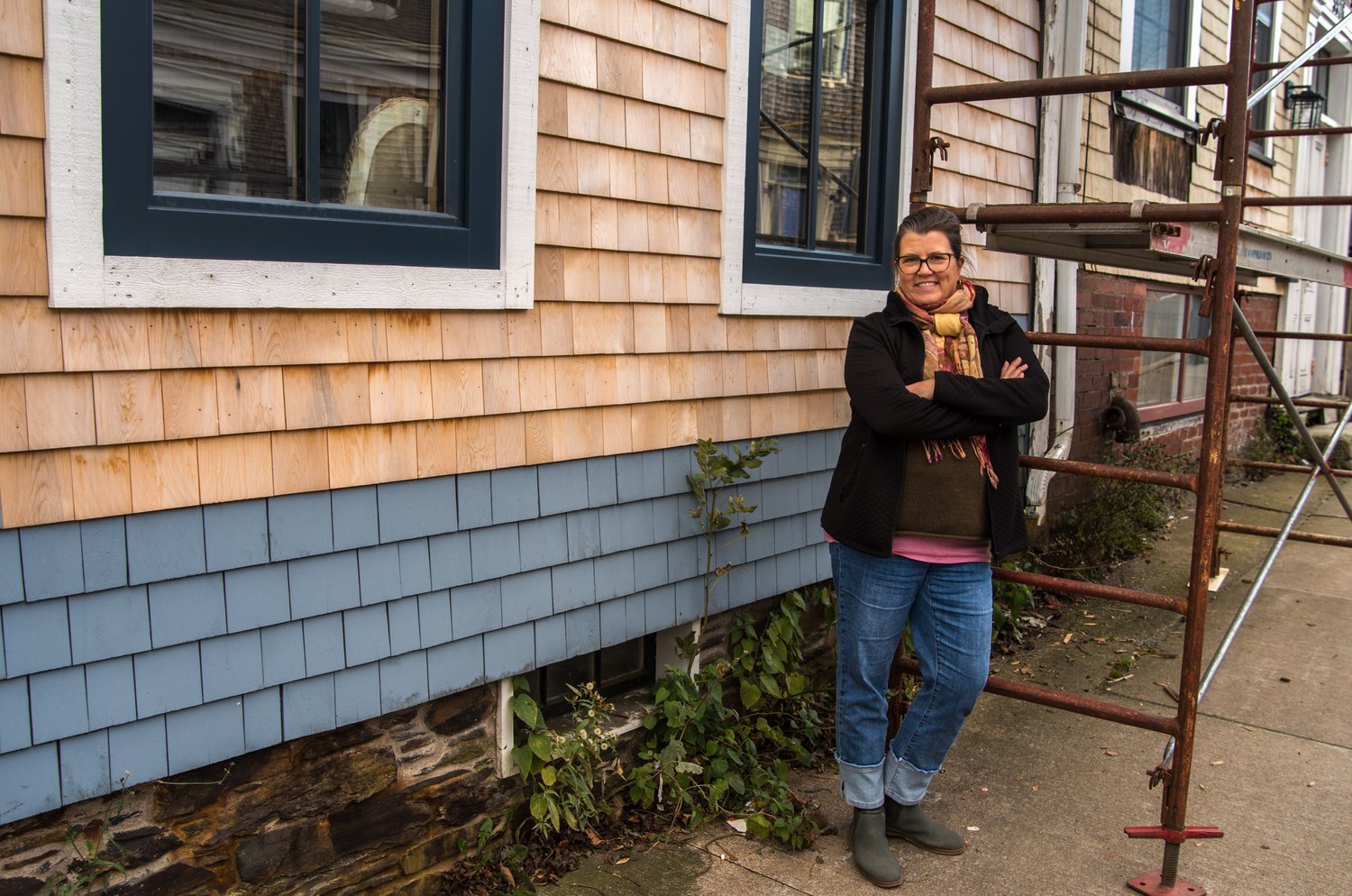
Lara Ryan, Senior Advisor to the Building to Zero Exchange, outside a home undergoing energy efficiency retrofits. Photo by Sean Kelly.
Green homes really do make senses – and cents – for homeowners, Ryan believes.
“Builders may pass on extra costs to be net zero ready – although this premium is not as big as some might think – but we need to look at lifetime operating costs of a building, not just the initial sticker price,” she says. “Then, we have to do a better job communicating that this is the better deal for the buyer.”
The Building to Zero Exchange has been created to share success stories, work on collaborative projects, and help the industry identify who’s doing what and who to connect with.
“We’ll have a resource hub and info on who is offering training,” says Ryan.
“We’re not trying to duplicate what’s already happening,” she says. “And we’re not trying to eat anyone’s lunch. But we want to fill gaps in training and collectively figure out how best to move forward. We need leaders in this space to show what can be done – and to turn people’s heads.”
The Climate Story Network (now Climate Stories Atlantic) is an initiative of Climate Focus, a non-profit organization dedicated to covering stories about community-driven climate solutions.
Sign up for notifications of our latest free articles. You can unsubscribe at any time.