Rolling with the tide (REVISITED)
MARCH 2026 UPDATE:
A quick update on how things have been going with Mahone Bay’s Living Shoreline project since we last spoke for the 2023 article below.
Coastal Action’s work creating a living shoreline in the town of Mahone Bay is just wrapping up, with the final 90 metres — for a total of 150 metres — planned for completion in 2026. And things, says Jordan Veinot, the group’s climate change program manager, have been going (and growing) according to plan.
“They’ve been doing phenomenally,” she says, when talking about the various types of vegetation that were planted in the tidal wetland and vegetated slope.
Work Veinot refers to as “adaptive management” has taken place as part of the ongoing research and monitoring of the pilot site, with only slight modifications needed along the way, including the placement of Christmas tree trunks and branches at specific spots: those more open to the bay and more vulnerable to the impact of storms.
A model based off of similar work done in Virginia’s Chesapeake Bay, it’s not the first nature-based shoreline solution in Atlantic Canada, but the first which uses this three-step approach.
The project, originally planned to cover a 700-metre area of waterfront, experienced a bit of a hiccup, says Veinot, after a 2024 feasibility study found some issues with Mahone Bay’s harbour floor.
“Since the article came out [in 2023] we’ve discovered that the harbour bottom is not able to support the weight that the living shoreline would require along the full 700 metres,” she says.
That remaining 550-metre stretch will be completed by the town as part of construction being done under the banner of The Edgewater Project, which the town’s website calls “a once-in-a-generation opportunity to transform” the town.
The part of that plan aimed at continuing the fight against coastal erosion will include a number of initiatives, says Veinot.
“They’re doing more of a hard-armoured approach where the living shoreline isn’t feasible,” she says. “The raised multi-use trail will be supported by rock, which will serve as a sort of dyke along the shoreline.”
And what’s Veinot’s take away after her time working with the project up to this point?
“We need to understand that challenges are to be expected and to make sure to look at them as opportunities to grow, and for our project I think it’s been wonderful.”
For anyone looking for more info on Coastal Action’s Mahone Bay Living Shoreline project, or to keep up-to-date with future community events around the project, visit www.mahonebaylivingshoreline.com
-Pam Sullivan
Mahone Bay comes up with a creative way to combat climate challenges.

Photo courtesy of Coastal Action
Residents of Mahone Bay, Nova Scotia, don’t need to be convinced the climate’s changing. Over the past few decades, it’s been as obvious as a hurricane, each – like Juan, Fiona, and Lee – coming harder and higher than the one before.
“That’s what they used to call the 100-year storm,” said mayor David Devenne. “But we seem to be getting it every five years now. They’re going to get worse. All the modelling suggests something needs to be done if we want to save the waterfront.”
After a series of floods, public meetings and a thorough consultation in 2015 with the Halifax-based engineering and environmental design consultancy CBCL resulted in Mahone Bay choosing an unlikely solution – grass.
A “living shoreline” is exactly what it sounds like – an extended, shallow ecosystem of robust native plants intended to buffer storm surges before they reach town.
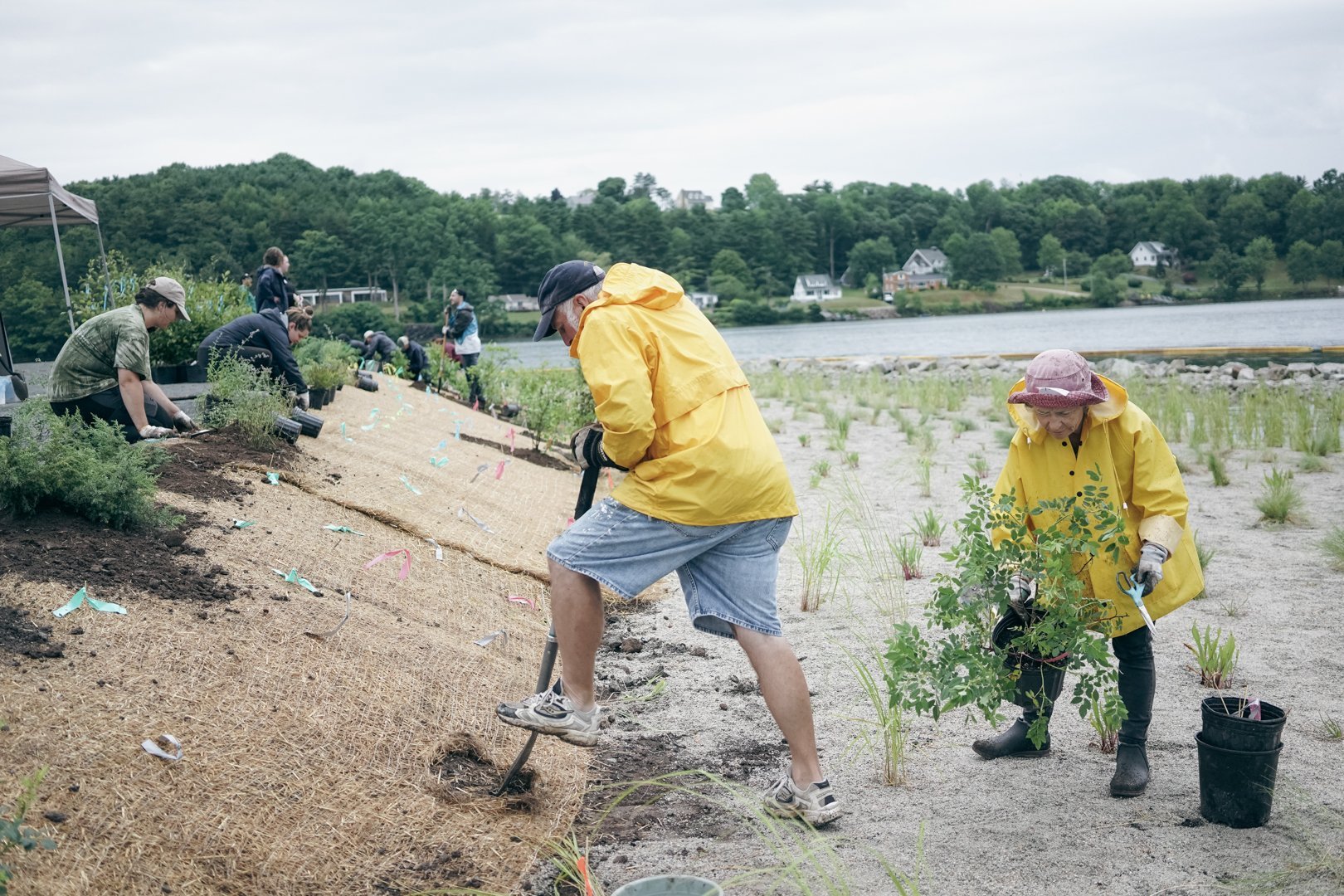
Working on the Living Shoreline. Photo by Gabriel Harding.
Instead of hiding behind a wall of cobble stone, as in decades past, Mahone Bay is raising a shield of Saltgrass, Prairie cordgrass, Sweetgrass, Seaside Goldenrod, Salt Meadow hay, and more.
“What we’re looking for are species that occur naturally in salt marsh ecosystems,” said Jordan Veinot, climate change team lead with Coastal Action, an environmental non-profit leading Mahone Bay’s living shoreline project.
This shoreline comes in three parts, she says. First, there’s a “rock sill,” erected about 15 metres from shore to take the brunt of oncoming waves. Between sill and shore is the tidal wetland, where the aforementioned grasses “exhaust” storm surges before they reach shore. Finally, there’s the shore itself, a “vegetated slope,” held in place by Ground juniper, lowbush blueberry, wild rose, Canada holly, Sweet pepperbush, and other salt-adapted species, stabilizing the shore while providing food and habitat for innumerable marine species.
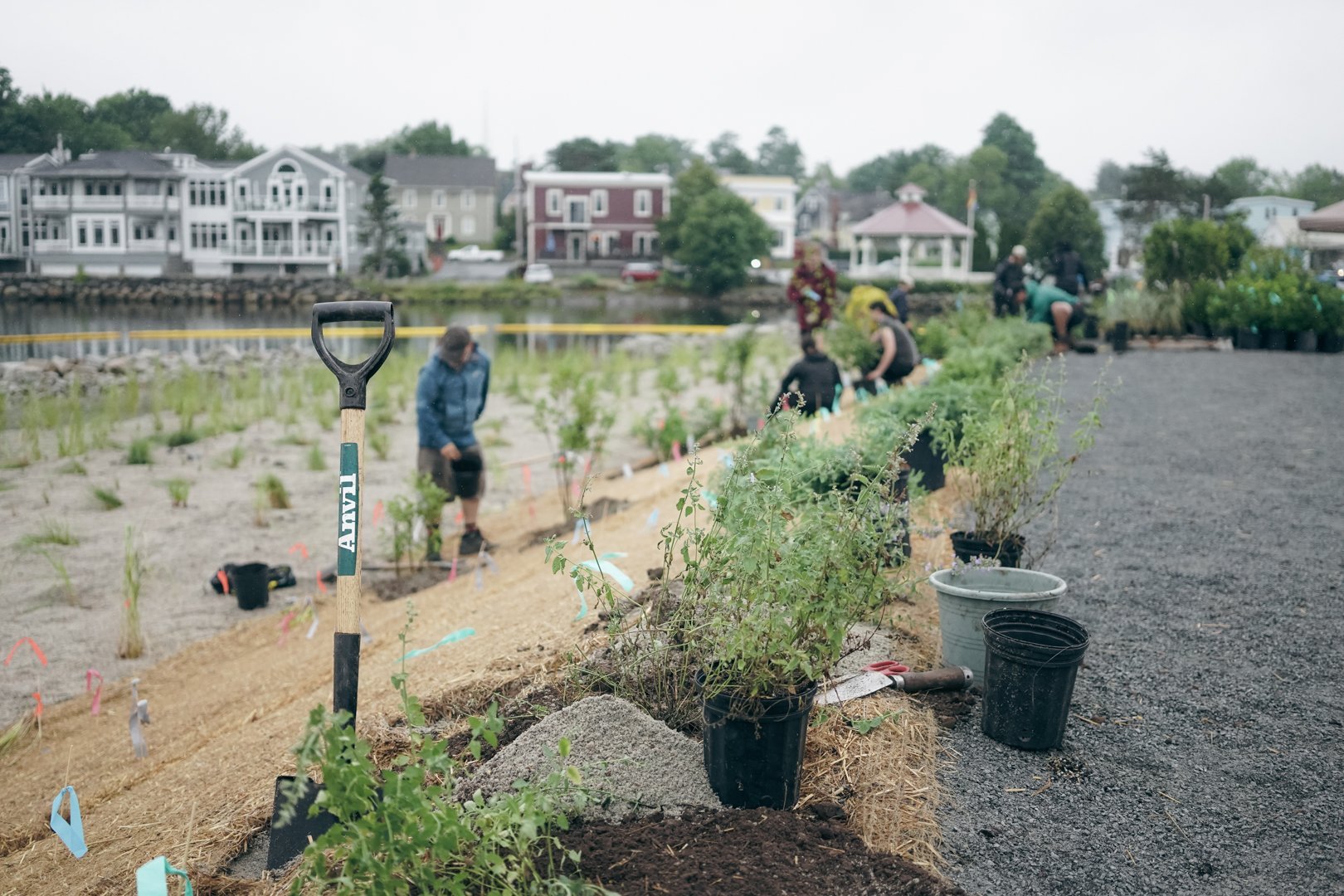
Working on the Living Shoreline. Photo by Gabriel Harding.
The living shoreline will eventually protect 700 metres of waterfront along Edgewater Street, from the mouth of Ernst Brook (downtown) to Mushamush River in the bay’s northeast. This is the part of town identified as most vulnerable to future storm surges by the modelling company 3D Wave Design.
Coastal Action is erecting the shoreline in chunks as funds become available. The first 60 metres were installed in the summer of 2022, with financial support from the Intact Financial Corporation, the TD Green Spaces Grant, and the Town of Mahone Bay, costing just shy of a million dollars.
The next 100 metres, coming in 2024, will cost just over a million, paid for with matching contributions from the Town of Mahone Bay and the provincial government’s Sustainable Communities Challenge Fund. Veinot estimates the remaining 540 metres will cost another $6 million, for which Coastal Action and the town are seeking funds.
“What we have now is 60 metres of a 700-metre project,” said Veinot, emphasizing the need to complete the project. “It’s not intended to withstand the full brunt of any storm on its own.”

Mahone Bay in fog. Photo courtesy of Coastal Action.
Edgewater Street is not only the most vulnerable stretch of Mahone Bay, but in some ways the most valuable. Two historic properties, the Alexander Kedy House and Bayview Cemetery, are located there, as well as Mahone Bay’s famous three churches – Trinity United, St John’s Lutheran, and St James Anglican, counted among Nova Scotia’s most recognizable landmarks.
“These three churches are probably the key to tourism in Mahone Bay,” said mayor Devenne. “And tourism is our number one business.”
Patti Brace, rector of St James Anglican, crosses her fingers every time a storm hits Mahone Bay. Her church, built in 1885, is especially vulnerable to wind and waves, and when storms do come, it’s not a question of if the basement will flood, but how badly.
“The living shoreline absorbs the water instead of resisting it, and I think that’s very smart,” said Brace. She’s seen it work.
During hurricane Lee, the parking lots lining Edgewater Street flooded, as usual, but the parking lot immediately behind the living shoreline didn’t.
This makes Brace optimistic, for both the future of the project and of her church.
“I went over there after Lee,” she said, “and I was impressed to see the shore hadn’t washed away, and the plants were still holding. It’s had a couple little trials now, and it seems to be doing a good job.”
The Climate Story Network (now Climate Stories Atlantic) is an initiative of Climate Focus, a non-profit organization dedicated to covering stories about community-driven climate solutions.
Sign up for notifications of our latest free articles. You can unsubscribe at any time.