Agrivoltaics: pairing unlikely bedfellows
Local research in the new and promising field of agrivoltaics, which pairs farmers and solar installations, may be a game changer in a time of increasing climate uncertainty.
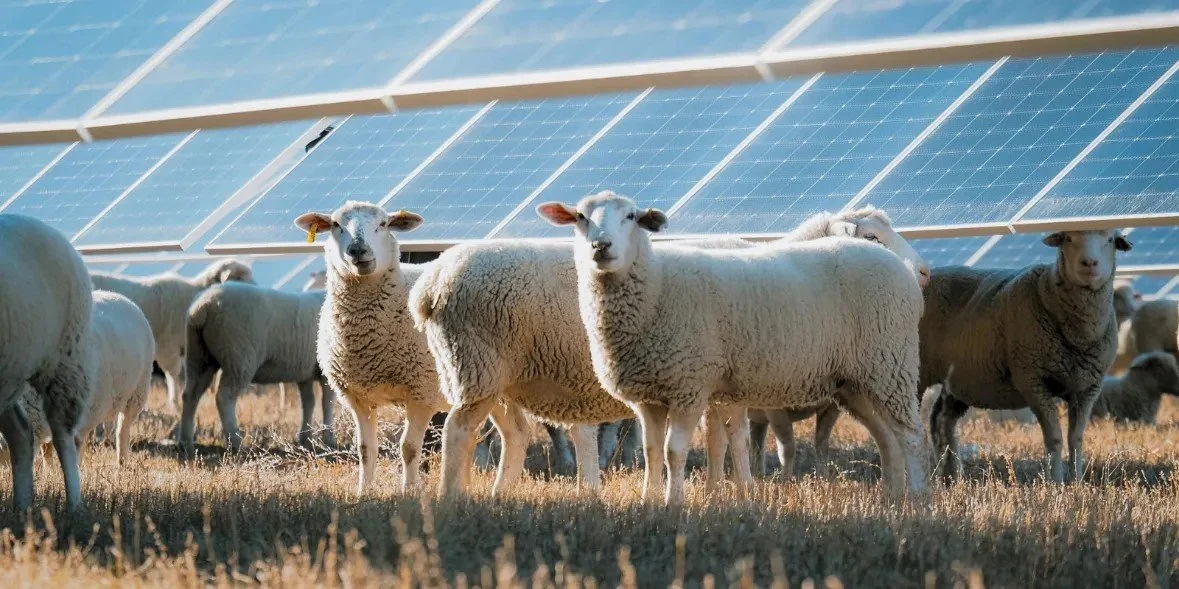
A herd of sheep grazing under and around a solar array. Photo courtesy of Agrivoltaics Canada
Sheep grazing around solar panels and berries thriving under the partial shade of a solar panel are just two of the many possibilities of combining farming with solar installations. It’s a fascinating idea that just may hold part of the solution to agricultural challenges faced in a time of the extremes of climate change.
That practical and creative idea is at the heart of agrivoltaics, a relatively new concept for Canada, and even newer for Nova Scotia, whereby solar voltaic panels are paired with growing crops and grazing livestock.
Local research work on the agrivoltaics front has been taking place at Dalhousie’s Agricultural campus in Truro since 2022, where, they’ve just wrapped up their latest feasibility study — funded by the province’s Low Carbon Communities (LCC) fund; research they’ve done alongside the Nova Scotia Community College (NSCC) looking at how agrivoltaics can help farms cope with climate change while also generating cleaner, cheaper energy.
Stephanie Macphee, Executive Director of the Office of Sustainability at Dalhousie University, is excited at the progress they’ve made toward understanding the possible inherent benefits of agrivoltaics.
“The summers are getting hotter, and you often have livestock grazing in fields without a lot of shade. These solar panels provide shade for the livestock, which has been shown to reduce heat stress,” she says.
And if summer 2025 was any indication of things to come for the province, smart new ways to help farmers deal with extreme weather will be of paramount importance.
There have been a number of crops, says MacPhee, that tend to thrive in a shaded and more protected environment, including small berry crops, apples, peaches, grapes, and leafy greens.
“There was an application that was well studied in the Netherlands for growing raspberries that’s been quite successful because raspberries tend to be susceptible to mold and so protecting them from getting too much rain is important,” she says.
Over the last year, Dal and NSCC have completed additional research in the form of another feasibility study to determine the top five locations on Dal’s Agricultural Campus in Truro for study installations. The five options, says MacPhee, vary in solar array size, electricity generation potential, and land use type (livestock grazing, research, and crops).Through this most recent study, says MacPhee, they’ve also gained a better understanding of specific Nova Scotia crops that could benefit from agrivoltaics, such as raspberries, and have researched more creative applications such as installing vertical solar PV panels to act as fencing to keep deer out of crops being used for research.
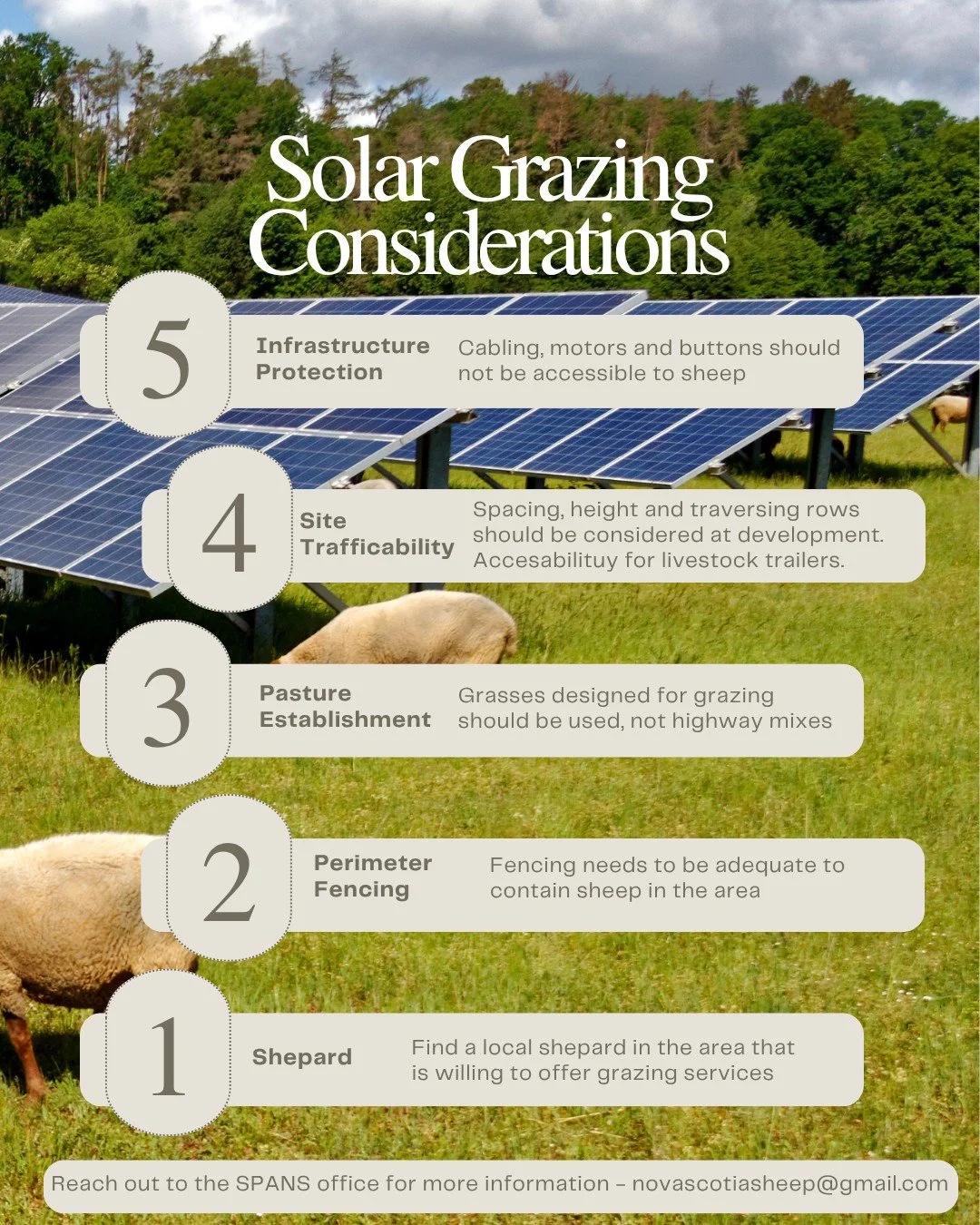
An ACMA infographic on the do’s and don’ts of solar grazing. Photo courtesy of ACMA
And in terms of farmer interest, MacPhee says it’s still early days, though adds that one of their students recently visited the Halifax’ Farmers’ market, noting a “significant level of interest” in the idea with small farm owners she approached. As with most things though, cost is obviously the ultimate unknown.
“You know, if you have a solar-ready roof vs the racking required for ground-mounted solar, it tends to be more expensive,” MacPhee says.
In its purest sense agrivoltaics is the combining of solar with crops and grazing livestock, and although there are no examples of that yet happening in Nova Scotia, Jeff McAloon, co-founder of the Smart Energy Company, which helps farmers generate their own energy independence and a director with Agrivoltaics Canada, says a wider definition could also include all farms with solar installations, of which there are many in the province.
“Certainly, there are a wide range [of solar installations] around the Maritimes, and there are some that are, you know, incorporating it more on the lower end, but there are some that intend to have animals grazing under their panels,” he says.
McAloon is referring to a large installation they’ve recently commissioned for Noggins Farm in Port Williams, Nova Scotia, where their intention is to bring in sheep to graze under and around the panels. That kind of grazing is currently happening around the province in a lease out-type arrangement, with shepherds dropping off sheep to graze or mow the grass around solar fields. Something Geoff Larkin, a local cattle farmer and Climate Adaptation Coordinator for Cattle and Sheep with The Agri-Commodity Management Association, promotes as a win-win for both groups.
“The whole idea is that the solar company, instead of mowing, hires a shepherd, who provides a vegetation management service, whereby sheep are brought in a few times a year to eat the grass,” he says. “I’d also love to see a development go in that can handle cattle. The posts have to be higher, of course, because cattle are taller than sheep.
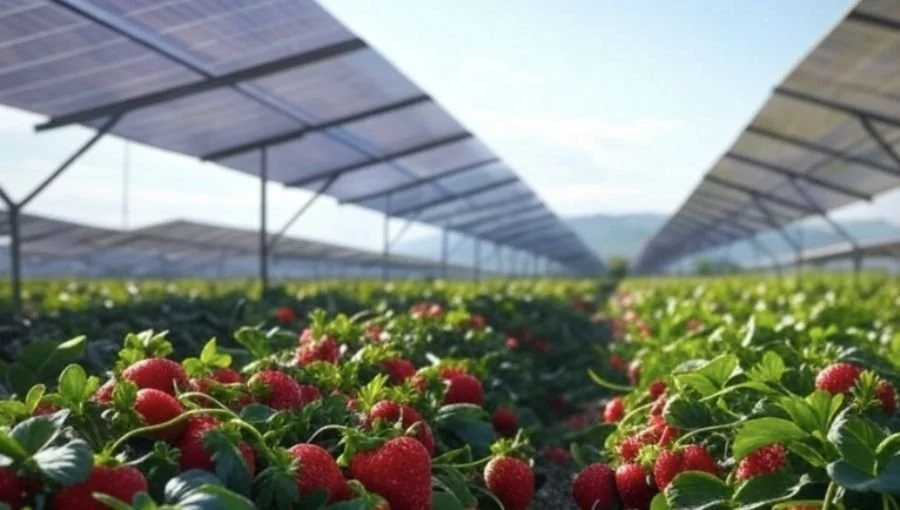
Strawberries under solar panels. Photo courtesy of SolarVision.
Internationally, agrivoltaics is in use in countries like the US, Germany, Japan, the Netherlands, and Australia. In Canada, McAloon says agrivoltaics is making it’s way from west to east, and up to now has mostly been driven by utilities developing large scale solar and the land to do that, which is where farmers have typically come in.
“Farmers have land, they’re often revenue constrained, and so will often trade growing space for land lease to a developer to do a massive 10- or 20-acre solar development,” he says. “But then this is where a mature balance between Agri and solar has to come together because if we’re purely trading that off for arable land, we’re not producing food.”
He says that realization for governments, associations, and farmers has resulted in a “we’ve swung the pendulum too far, so now we have to bring it back to balance,” kind of reaction.
Another one of McAloon’s customers has been McCain’s food, where his company installed a solar installation for a “farm of the future” concept in Florenceville, NB, which includes agrivoltaics. McAloon’s team had originally tried to set up the panels to “not take crop space,” but was surprised when that’s exactly where the farm wanted them installed.
“They wanted to take a look at the pollinating species of plants that would grow under the solar and how that would impact the [potato] field that was adjacent to it,” he says.
And in terms of next steps on the research front here in the province, MacPhee is hoping to secure funding to start a pilot project to further the university’s research. Initial research showed increased yield in 10 of 26 crops they looked at, and no change in 11 others. Next steps in the form of a pilot project could work through the many permutations and combinations that effect plant growth.
“There’s more and more interest in this area and knowledge is increasing on the topic, but more research needs to be done at a local level to really gain an understanding of how this can best be applied in Nova Scotia,” MacPhee says.
Meanwhile, McAloon says the willingness of utilities to be “more open-minded” also plays a big role in giving farmers the piece of mind they need to move ahead with costly installations around solar and agrivoltaics.
One obstacle says McAloon is “the restrictive policies and rules utilities still have around solar,” though seems hopeful that can change with time and a better understanding of solar and the grid.
“They’re trying to learn, and they have aged distribution and transmission systems, and are still fairly new to understanding solar. So, I think some of the challenges are around them understanding that when someone has solar, they’re actually taking constraint off the grid.”
Climate Stories Atlantic is an initiative of Climate Focus, a non-profit organization dedicated to covering stories about community-driven climate solutions.
Sign up for notifications of our latest free articles. You can unsubscribe at any time.