The rise and fall…and rise again…of tidal turbines
After a few hits and misses, and for the first time since 2018, looks like Nova Scotia tidal power is on the move again, attracting some industry heavy hitters.
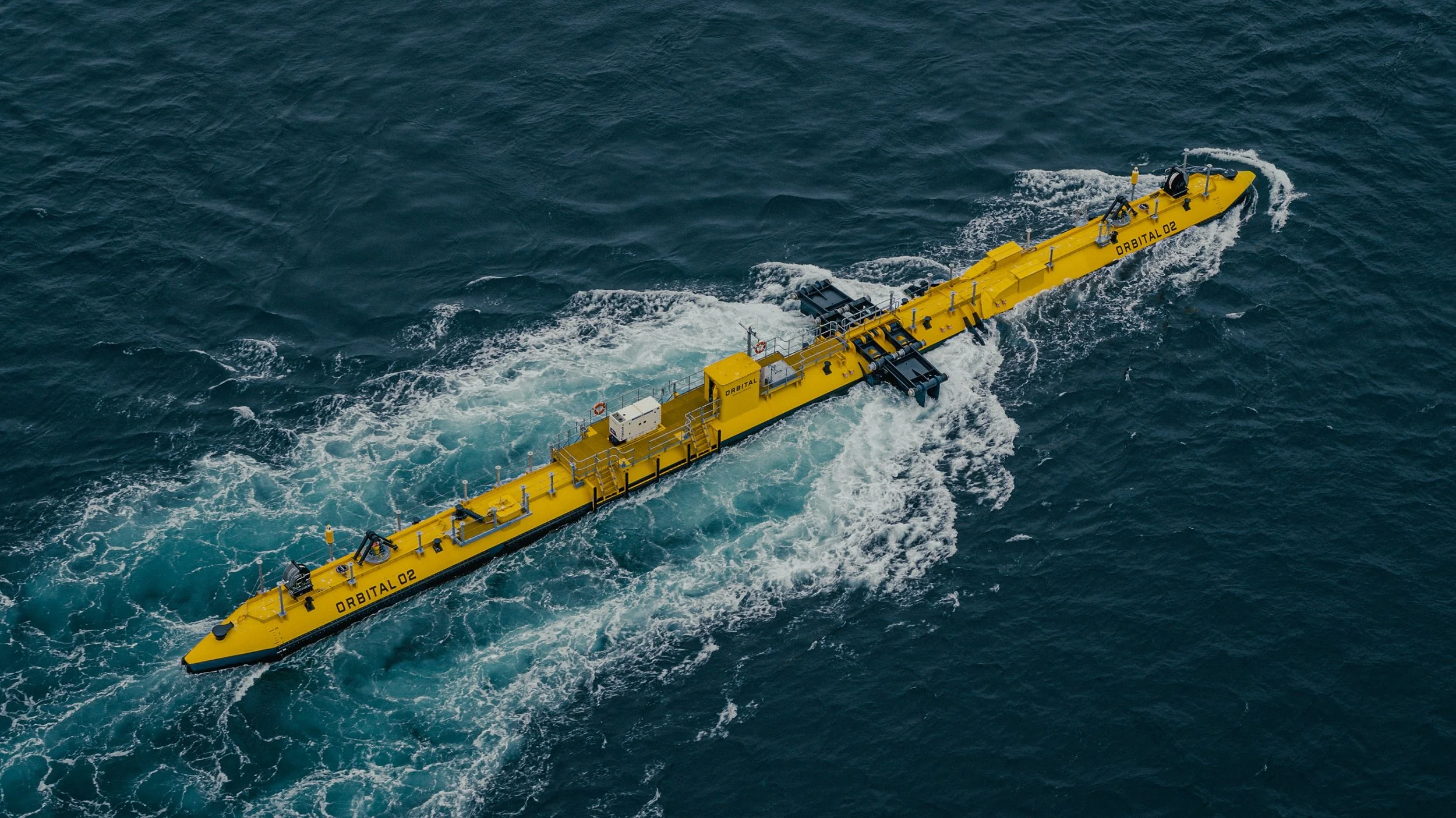
The UK-based Orbital Marine Power’s O2 turbine. It’s successor, the 02-X will be deployed in the Minas Passage. Photo courtesy of Orbital Marine Power.
Twenty years ago, it was anyone’s game. The frontier of renewable power was still wide open, with wind, solar, hydro, tidal, geothermal and nuclear all mentioned in the same breath — their potential and practical limitations still largely unexplored. Until they were.
Since then, solar has become the cheapest power on the planet — in fact, the cheapest power in human history — with wind close behind. Nuclear has been bogged down by new regulations and rising capital costs, while geothermal has produced a lot of cheap power for the very few countries with the right geology. All rivers worth damming have been dammed, and the ecological consequences have been sobering.
But what’s happened with tidal? Anchor a few turbines to the seabed, and you can harness tides the same way you harness wind, but unlike wind — whose output fluctuates wildly with the weather — tides are predictable down to the minute, and therefore, down to the megawatt. So where are those reliable megawatts?
The problem has been, and continues to be, a lack of investment. In order to provide harvestable power, tides need to be pinched between landmasses, where their gradual rises and falls become currents heavy and strong enough to justify a turbine. There are approximately 50 sites globally with commercially viable tides, 10 of which might turn an investor’s head. Fewer sites have meant fewer companies deploying fewer turbines, and so, slower progress.
“Tidal power is at least a decade behind wind and solar, and it’s been a decade behind for 20 years now,” says Richard Karsten, professor of mathematics at Acadia University, and co-founder of the Acadia Tidal Energy Institute, a collection of academics studying the potential for tidal power from the world’s highest tides.
Squished between Nova Scotia, New Brunswick, and Maine, the tides of the Bay of Fundy fluctuate as much as 16 metres every 6 hours and 13 minutes. A few narrow passages concentrate these tides still further, into very fast, very productive currents, like that of Petit Passage on Digby Neck, and the Digby Gut, though which water accesses the Annapolis Basin.
But none hold a candle to Nova Scotia’s Minas Passage. Through this gap, five kilometres wide and 150 metres deep, Fundy tides flow frantically in and out of the Minas Basin. During the high spring tides, more water flows through this passage than flows down all the rivers on the planet combined, and it does so at up to five metres per second.
The Minas Passage is a force of nature, says Karsten, and blocking too much of its flow — with an excess of turbines — could have disastrous consequences for shorelines throughout the Bay of Fundy. He’s calculated that 800 megawatts of electricity could be safely generated, roughly the output of a large nuclear reactor, or half the peak demand of the province of Nova Scotia.
“I don’t know if we’d ever get it all,” he says, “but a couple hundred is a very realistic possibility.”
People have been designing turbines for the Minas Passage since 1915, but things didn’t get serious until 2009, when the Fundy Ocean Research Centre for Energy (FORCE), a not-for-profit research facility in the Bay of Fundy, established five “berths” in the Minas Passage, with the underwater electrical hookups necessary for tidal companies to test their turbines, and to deliver power to the provincial grid.
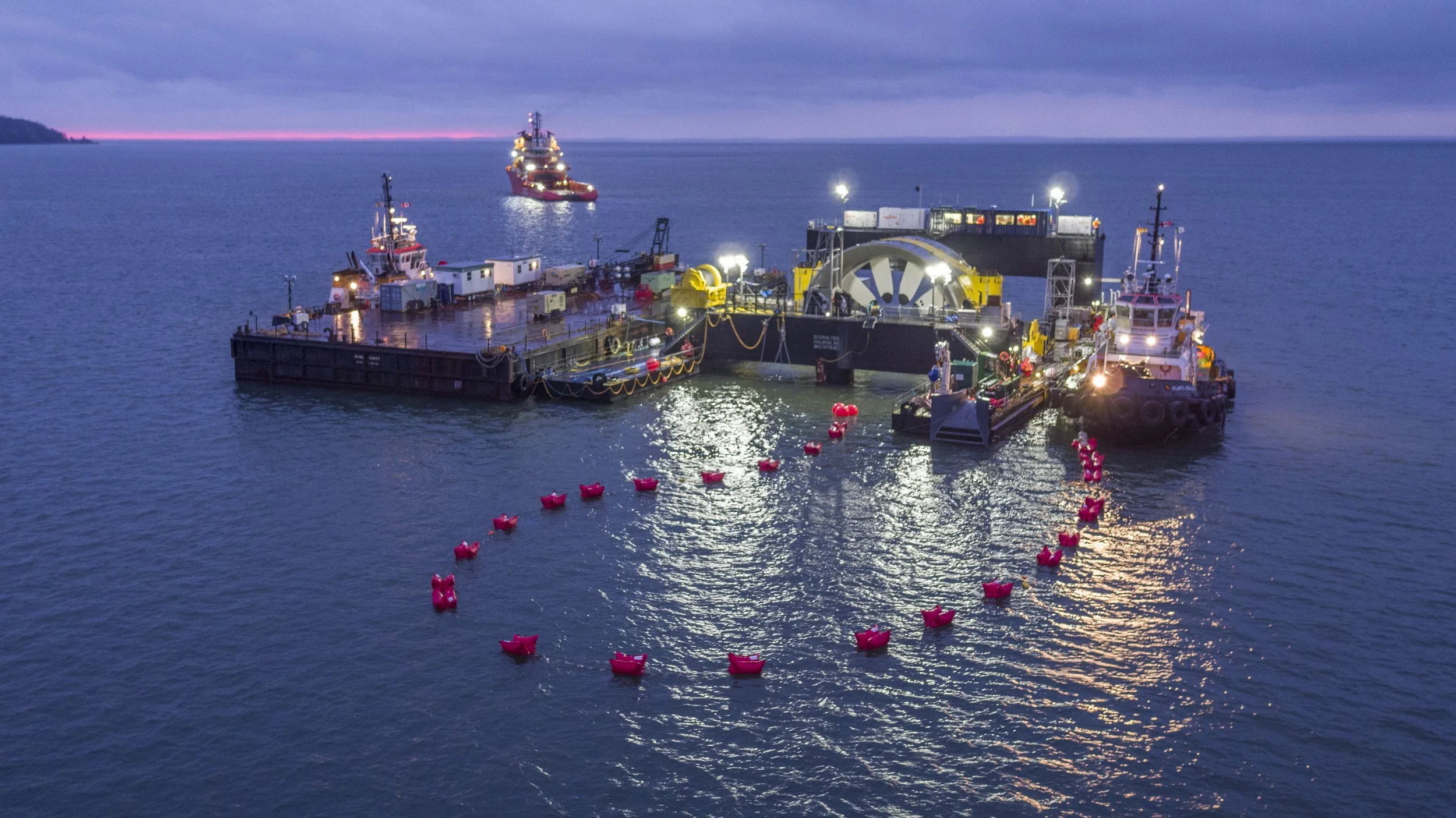
The Ireland-based OpenHydro turbine. OpenHydro went bankrupt in 2018, just six days after its turbine was lowered into the Minas Passage. Photo courtesy of FORCE.
But the industry was too young, and the regulatory hurdles too odious, for FORCE to reach it full capacity. Only one company — the Ireland-based OpenHydro — ever deployed any turbines. The first (2009-2010) was destroyed by the current, and the second (2016-2017) was only a brief test. The third was lowered into the water in 2018, six days before OpenHydro went bankrupt. The turbine never generated any power and never came out of the water.
“I’ve gotten pretty pessimistic about tidal power over the last five years,” says Karsten.
But a lot’s changed in those five years. Not only has tidal made huge strides — at places like the European Marine Energy Centre — but the governments of Canada and Nova Scotia have streamlined their approval process for turbine deployment at FORCE. In 2024, this process attracted some serious players, approving its first turbines since 2018.
“We’ve been working with renewed vigour since then,” says Lindsay Bennett, executive director of FORCE.
The turbines in question are being manufactured by the UK-based Orbital Marine Power, which deployed its “O2” turbine off Orkney Island, Scotland, in 2021. This is the most powerful tidal turbine presently in the water anywhere, reliably powering 2,000 homes annually. Now they’re building a successor, the O2-X, which the Canadian company Eauclaire Tidal plans to deploy over three of FORCE’s berths. The province of Nova Scotia has approved them up to 16.5 megawatts, timeline to come.
FORCE has been in communication with several tidal energy companies over the years, says Bennett, adding that there’s been a marked shift since 2024. Eauclaire Tidal and Orbital Marine Power are established companies deploying proven turbines, and she expects more to come.
“If Orbital can deploy their turbines here in the next three or four years, that would be a turning point,” says Karsten. “They aren’t coming here to prove their turbine works. They’re coming to generate power.”
Climate Stories Atlantic is an initiative of Climate Focus, a non-profit organization dedicated to covering stories about community-driven climate solutions.
Sign up for notifications of our latest free articles. You can unsubscribe at any time.