Doing our dirty work
Oysters, “ecosystem engineers,” prove their mettle in Boat Harbour inlet, showing they could be part of a nature-based approach to remediating one of Nova Scotia's most polluted marine sites.
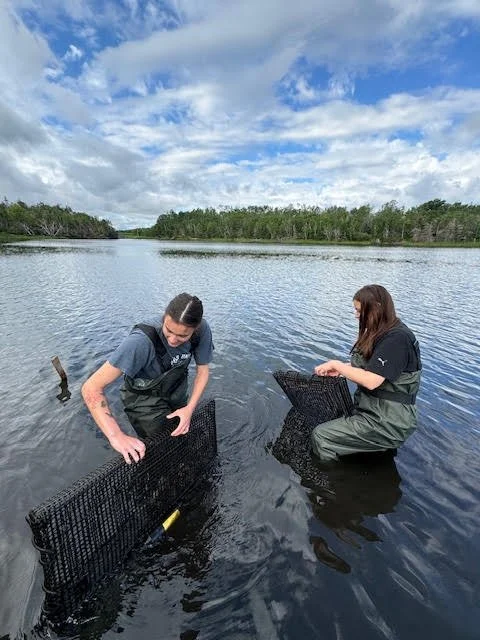
Members of Dr. Filgueira's team check the oyster cages. Photo courtesy of Jasmine Talevi.
When Ramon Filgueira placed three cages filled with oysters in a shallow cove linked to Nova Scotia's notorious Boat Harbour, he wasn't sure what their fate might be.
It was the summer of 2024, and the marine biologist was taking the first step in an innovative and ambitious trial he and his team hoped could help clean up one of the province's most polluted marine sites.
Dr. Filgueira, an associate professor in Dalhousie University's Marine Affairs Program, knew that the mollusks were being used around the world to clarify water, remove pollutants, provide habitat for hundreds of species, and create natural defences against storms by muting the force of large waves.
So, Dr. Filgueira wondered if the rough-hewn bivalves (oysters) — dubbed “ecosystem engineers” for their ability to filter gallons of water a day — could do the same in Boat harbour, a tidal estuary that was converted into a treatment basin for effluents from a local pulp mill near the Pictou Landing First Nation (PLFN). The mill, which closed in 2020, contaminated the waterway and restricted the First Nation's traditional use of the harbour due to a toxic sludge that settled on the bottom.
First, he had to see if 225 oysters provided by a local supplier could survive in the area.
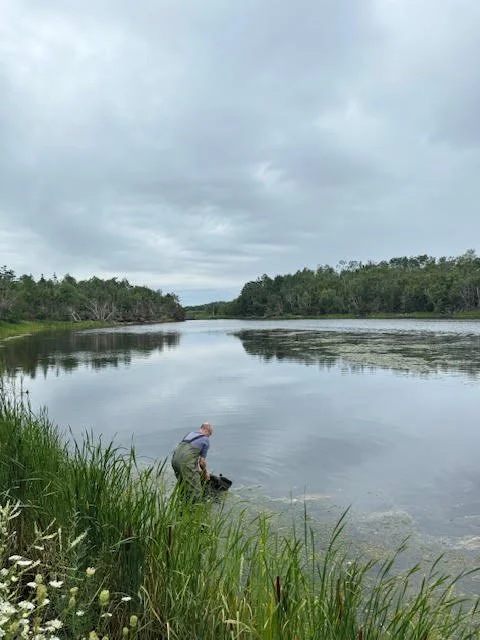
Ramon Filgueira handling one of the cages in A'sek (Boat harbour). Photo courtesy of Jasmine Talevi.
"We were afraid that all of them might die or wouldn't grow, and if that happened, we knew this is not a good place for them," he says. "But the outcome was very positive because they not only survived, they also grew like a regular oyster would. So, this suggested that while the waters of Boat Harbour are not in great shape, they are not that bad that oysters cannot do their job."
That job, in ideal situations, can see a single oyster filter six to seven litres an hour or 50 gallons a day. The nature-based solution is being used in jurisdictions around the globe. The Billion Oyster Project was started in 2014 and is restoring oyster reefs in New York Harbor, which once had 220,000 acres of oyster reefs.
In Europe, the Native Oyster Restoration Alliance is working to restore a European oyster and its habitat. And in Hong Kong, oysters are being attached to seawalls to improve water quality and bolster seawall protection.
Dr. Filgueira collaborated with the PLFN, ShanDaph Oysters, and Dartmouth’s Centre for Marine Applied Research, on the initial pilot to evaluate site suitability and capacity for an oyster remediation project in the region. Now, knowing that the oysters can survive and grow there, they want to expand it to a small-scale project to see whether more oysters could colonize the area.
The hope is that they would grow and eventually create a reef that would spread.
Working closely with the PLFN community, Dr. Filgueira is applying for funding to expand the project and develop knowledge mobilization opportunities, like citizen science events and a documentary that would educate people in Nova Scotia about the role oysters can play in rehabilitating water, while informing them of the history of Boat Harbour, or A'sek in Mi'kmaq.

Measuring oysters that had been in the cages to see if they had grown over the last year. Photo courtesy of Jasmine Talevi.
For 36-year-old Jessica Denny, who is working with Dr. Filgueira on the project, that history goes back to her grandparents and their memories of how the waterway was transformed after the mill opened.
"It was where my grandfather fished, where he lived off that water. They ate the food from there. They all swam there. It was their haven and when the mill came, it destroyed everything," says Denny, an engagement officer with the PLFN Indigenous Habitat Participation Program.
"So, it’s important to help clean it as much as I can while I'm here. I grew up with my grandmother, and our house is literally 100 feet from the water, and I remember her telling me, 'Do not go near the water, don't touch it, don't drink it.' I was taught to fear it, where they were taught to embrace it," she says.
The oysters are much like little vacuum cleaners, says Dr. Filgueira, so those that were in the cages will be examined to see if they absorbed heavy metals, which would be trapped in the ocean floor once the oysters die.
He hopes to distribute more oysters next spring if the funding is granted and the project, supported by the Ocean Frontier Institute, continues.
Denny says the oyster work won't provide a quick fix, but will play a part in larger remediation programs.
"When Ramon came to us and said that a lot of them survived and grew, I was so happy," she says. "I'm not saying it's going to fix the whole problem, but if we're willing to start something that's beneficial and is natural, why not, especially when our community relies on our fisheries and our water."
Climate Stories Atlantic is an initiative of Climate Focus, a non-profit organization dedicated to covering stories about community-driven climate solutions.
Sign up for notifications of our latest free articles. You can unsubscribe at any time.