The greening of Sable…and a little bit more
A look at recent green upgrades to Sable Island and a peak into life and work on this alluring, mystical, and much adored overgrown sandbar.
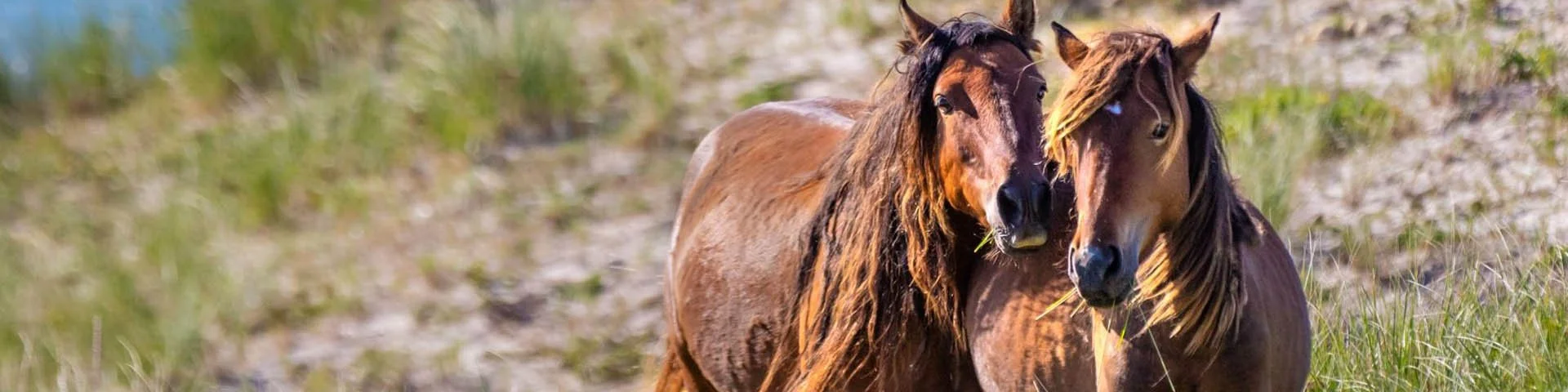
Two of the island’s famous horses enjoying what is likely a very welcome sunny, hopefully warm day. Photo courtesy of Parks Canada.
A mythical island 160 kms off the coast of Nova Scotia is now getting a positive boost to its already alluring reputation due to the greening of its infrastructure.
Sable Island National Park Reserve, more commonly known as “Sable” or Sable Island, is in the middle of the implementation of a sustainable micro-grid system to “support Canada’s transition to a greener economy.”
Established as a protected national park in 2013, the changes, says Sable Island Park Manager, Mathieu D’Astous, help the park fall in line with both the Parks Canada Departmental Sustainability Development Strategy, as well as Canada’s Greening Government Strategy goals of “reducing greenhouse gas emissions to zero by the year 2050 from all Government of Canada operations.”
An operations team that includes an operations coordinator as well as two support staff — mainly working on research files — are on the island at all times. The operations team is responsible for managing the infrastructure as well as all the operational systems on the island: overseeing potable water, the power generation system, visitor safety, as well as the safety of researchers, and everybody else who visits the island.
“We have a minimum of three people on site at all times, and they do a two-month on, two-month off rotation — essentially spending half the year on the island,” D’Astous says.
Prior to Parks Canada taking over, the Canadian Coast Guard acted as the island’s caretaker, sharing the land with a meteorological service. There are currently approximately a dozen buildings on Sable, three of which are for accommodation — all built pre-Parks Canada — in addition to another nine, which comprise what’s commonly referred to as the “main station”. Some act as storage for vehicles, others as workshop areas, storage for food, as well as equipment and power generation. There’s also an area of the island that contains various pieces of equipment from Nav Canada — Canada’s air navigation provider — and Environment Canada. In another area, called the West Light, there’s an old lighthouse keeper’s house that Fisheries and Oceans Canada uses during the winter for their grey seal research program. Sable Island is the largest breeding colony of grey seals in the world, something, says D’Astous, that’s welcome news for a certain conspicuous group just offshore.
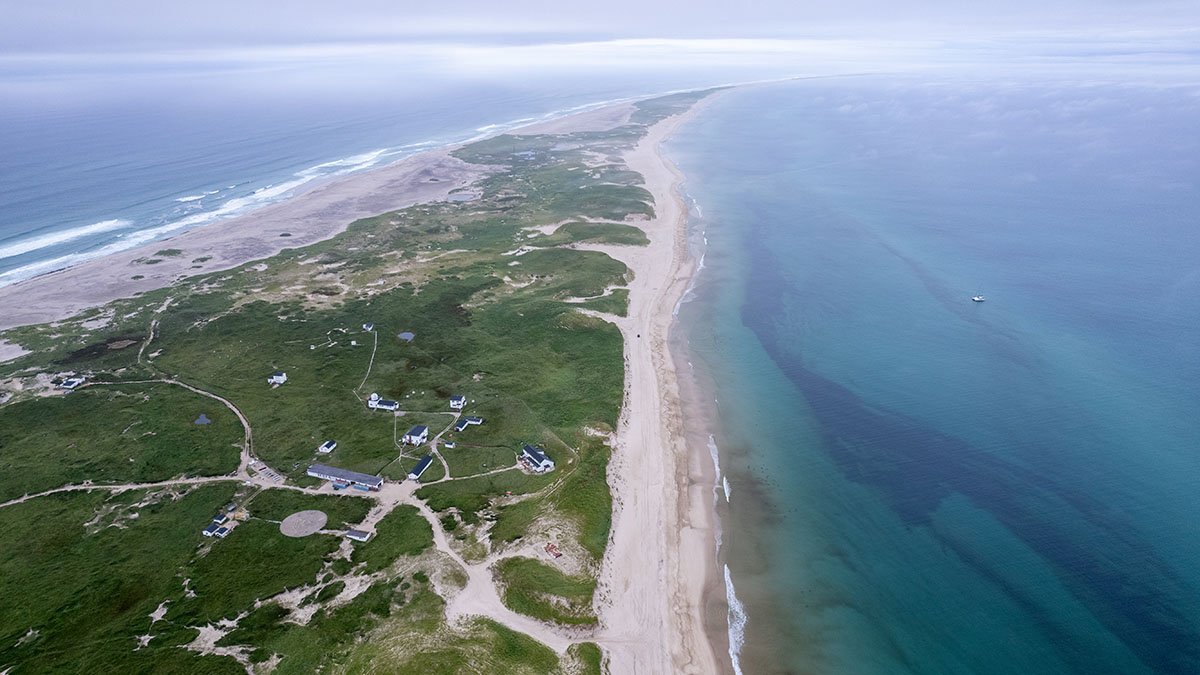
An aerial view of Sable Island showing the “main station”. Photo courtesy of Parks Canada.
“One of my colleagues used to say that it’s like a very large grocery store for sharks — including great whites — so obviously not a great place to swim,” he says.
Although there’s been some sort of presence on the island since 1801 — whether for pirates, prisoners, shipwreck rescuers, or lighthouse keepers — diesel generators on the island have only been used since the 1960s (though possibly earlier). And it’s these generators, says D’Astous, and the CO2 they release, that Parks Canada is addressing with its retrofits.
“Those generators run at 100% no matter what, even if it’s only one lightbulb on, versus if we have all the lights on or radio equipment, etc.,” he says. “That’s really not an efficient system.”
Taking place from fall 2025 through spring 2026, retrofits will reduce the island’s electrical needs while upgrading its power generation system to a sustainable micro-grid. The $5.1 million federal government project will look at cutting diesel usage by more than 50 per cent by replacing two traditional generators with more efficient variable speed generators, with usage dictated by the specific demand at any given time. The new system also combines a small solar array with accompanying battery storage. Other upgrades include general energy efficiency upgrades, as well as upgrades to heating equipment, and the use of heat pumps — where possible, resulting in a more than 50 per cent decrease in the use of fossil fuels.
It should be noted that the island’s unique weather patterns, including a not unsubstantial amount of fog, translate into a difficult situation for implementing green energy solutions, including wind turbines, which are not feasible due to the increased likelihood of bird mortality on an island that acts as a crucial habitat for numerous bird species.
When asked about the future of Sable Island in terms of the effects of climate change, D’Astous says that’s difficult to predict given the “dynamic nature” of the island — basically a large sandbar.
“We’re sure that climate change will have an impact on the island, sea level as well, but it’s hard to pinpoint that specific impact…you see erosion in some areas of the island, but there are other areas where there are new dunes growing,” he says.
And for those interested in visiting the island, D’Astous says the two main ways to get to the island are helicopter and small fixed-wing planes, though he adds that landing can be a stressful affair owing to the shifting nature of a sandbar island.
“The plane actually lands on this very large sandy, flat area, but the runway changes location from time to time depending on conditions…with, on occasion, no runway,” he says.
Small visitor and expedition groups must get permission to land through the granting of a business license or permit combined with regulations and guidelines about how to visit in a responsible, safe fashion with limited impact, including a 20-metre buffer rule with respect to the famous Sable Island horse.
Climate Stories Atlantic is an initiative of Climate Focus, a non-profit organization dedicated to covering stories about community-driven climate solutions.
Sign up for notifications of our latest free articles. You can unsubscribe at any time.