A closer look at what’s behind the province’s openness to innovation and startup culture.
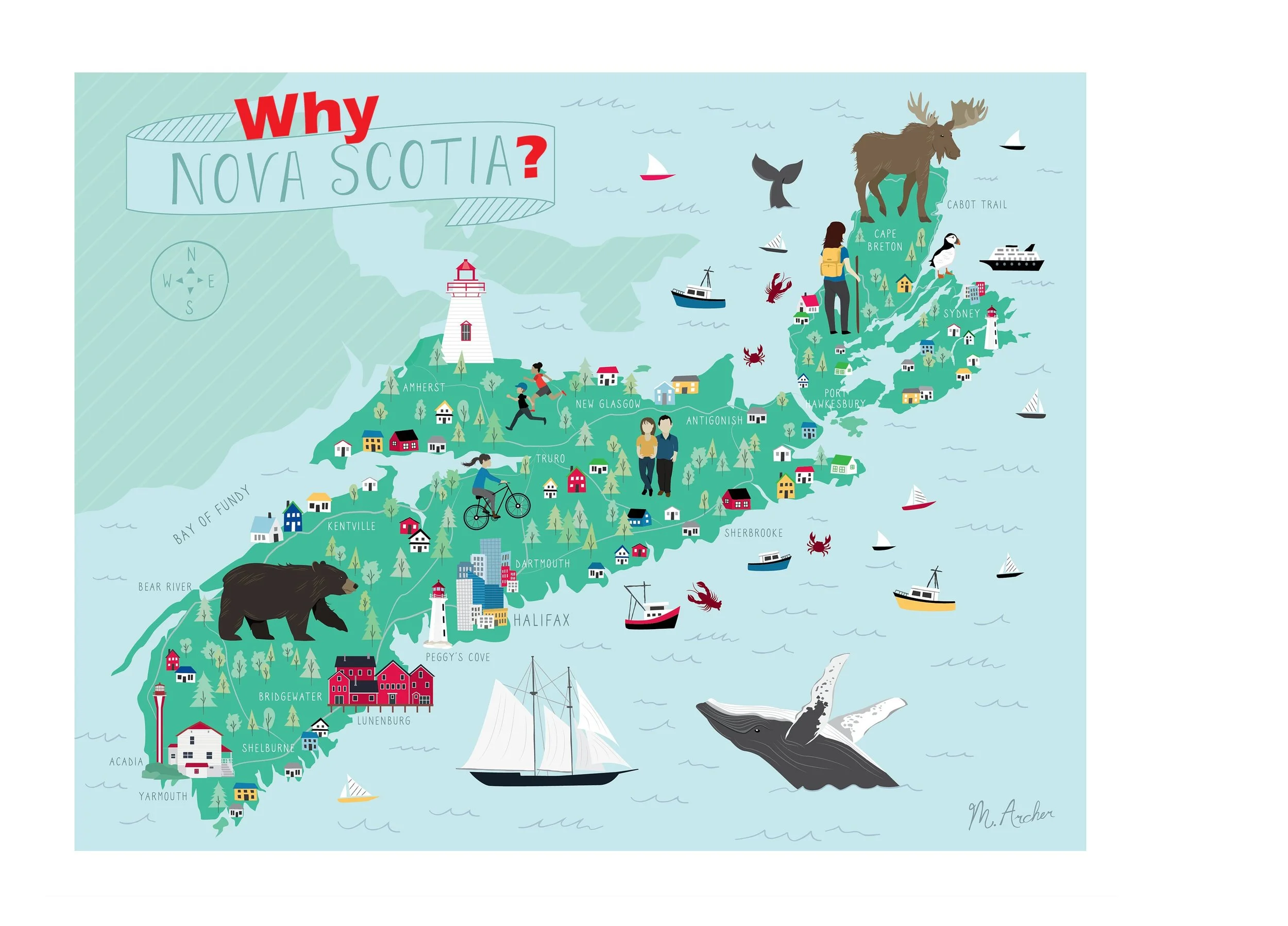
Ocean Alkalinity Enhancement (OAE) is still very new and still pretty rare, at least commercially, but with both Canadian startups working in the field — Planetary Technologies and CarbonRun —based in Nova Scotia, and a third company, pHathom, also developing ocean-based CO2 removal solutions, and also based in Halifax, something must definitely be in the water. So, what gives?
In all likelihood It probably dates back to 2014, when some very smart people — commissioned by the provincial government — published a report on Nova Scotia’s economic prospects. Their conclusion was grim.
“The evidence is convincing that Nova Scotia hovers now on the brink of an extended period of decline,” it reads. “Two interdependent factors — an aging and shrinking population and very low rates of economic growth — mean that our economy today is barely able to support our current standards of living and public services and will be much less so going forward unless we can reverse current trends.”
This report was entitled “NOW OR NEVER,” complete with capitalization, and the province took its recommendations seriously, very soon after starting to encourage immigration, attract and retain talent, and support innovation. Government representatives even attended learning sessions at the Massachusetts Institute of Technology, writing down radical ideas on how to reinvigorate the economy.
“There was a real concerted, intentional effort put towards innovation in the province,” says Miriam Zitner, at the time, head of the Halifax Innovation District. “We realized we were going to be in trouble if we didn’t do this, and that we had tremendous resources and opportunities we needed to maximize the potential of, in Nova Scotia.”
A suite of government-backed innovation funds, alongside accelerator and incubator programs, began popping into existence, and of the sectors receiving the most support — construction, biotech, defence, and power — ocean technology was highlighted as a provincial focus. OAE fits neatly into this category.
Today, Zitner is general manage of Carbon to Sea Canada, a domestic branch of the international Carbon to Sea Initiative, a charity whose mission is to put Ocean Alkalinity Enhancement to every conceivable test. They want to know if it works, if its carbon credits can be verified, if it’s safe for people and marine life, if it can be done at scales large enough to matter, and on and on.
To do this, they fund research and development. It’s hard to study OAE if no one’s doing it, so they went in search of promising startups just as Nova Scotia became a startup paradise. They ultimately put some money into Planetary Technologies — an engineering grant — and now the company’s a global leader in OAE, sequestering carbon and selling credits earlier, and at grander scales, than anyone else.
“There’s always been innovation here. There are just so many more technologies and sectors being mapped overtop of it right now,” says Levi Morrison, director of innovation with COVE, an international not-for-profit based in Halifax whose job is to get promising technologies out of the lab, and into the market.
One of the ways they do this is by pulling startups — with all their vigour and patents and new ideas — into a global network of economic actors, be that businesses or universities or not-for-profits, so everyone can learn from, and do business with, everyone else. Breaking isolation, in other words.
Planetary Technologies received exactly this treatment. They were paired with a gaggle of academics and entrepreneurs who wanted to study, and to build upon, their approach to OAE. This assembly of curious minds took place in 2024, hosted in partnership between Carbon to Sea and COVE. They called it a “Joint Learning Opportunity,” part commercial, part academic, part not-for-profit, and to the benefit of all three.
The result was a short list of international research and development projects drawing their data from, and testing their theories on, Planetary Technologies. For example, there’s a company in Seattle called Sequoia Technologies which, after attending the 2024 Joint Learning Opportunity, began designing remote sensing equipment specifically for OAE.
So, Nova Scotia’s lead is, in part, timing. The province began building an economy for the future, says Morrison, and the future needs carbon dioxide removed from the atmosphere. There was a good business case, and the province was open for business. But there’s another piece to this puzzle.
Nova Scotia’s coastline has some very unique features, says Morrison, like the Minas Passage, through which the highest tides in the world are squeezed several times a day. Nothing like this Passage exists anywhere else in the world, and so it’s no coincidence the tidal power continues to look toward Nova Scotia. The Scotian Shelf enjoys some of the most consistent winds in the world, so again, it’s no coincidence gigawatts of wind power are being proposed in the province’s offshore.
OAE is no different, says Morrison. Planetary Technologies takes advantage of the infrastructure, and the tidal flushing, of Halifax Harbour to mix in its magnesium oxide, while CarbonRun capitalizes on Nova Scotia’s acidic rivers, getting the job done with calcium carbonate. But these technologies can’t be deployed — let alone perfected — just anywhere.
“And the part you can’t physically see is the data,” says Morrison.
These coastal features have been studied intensely for decades, he says, with a wealth of time series data available for each; a precious commodity when you’re designing a multi-million dollar tidal or wind turbine or getting the chemistry right for OAE. The academics behind this data — Nova Scotia has the highest concentration of ocean-related PhDs in the world –— have been very willing to share, with a number of academics from Dalhousie, in fact being among the participants in the 2024 Joint Learning Opportunity.
“This region appears so ripe for [OAE],” says Morrison.
The Carbon to Sea Initiative launched a second Joint Learning Opportunity in 2026, this time in partnership with the Marine Environmental Observation, Prediction, and Response Network (MEOPAR), another non-profit which specifically funds ocean research. In total, these two Joint Learning Opportunities have birthed thirteen distinct research and development projects across North America, all of them building on Nova Scotia’s unusual concentration of OAE.
“Nova Scotia’s strength is the combination of ocean science, marine industry, and people who know how to work together,” says Jamie Snook, executive director with MEOPAR.
But he doesn’t expect this nascent industry to stay bottled up in Nova Scotia much longer. In fact, Carbon to Sea and MEOPAR are already funding OAE research and development projects outside the province and will soon be funding a lot more. If the province plays its cards right, he says, they could remain a spiritual leader in OAE, but probably not the only game in town.
“Nova Scotia is certainly in the lead right now,” says Snook. “Its opportunity is to build lasting leadership through credible science and public trust as the field grows internationally.”
This story is part of a special series on marine-based climate solutions that is supported by the Carbon to Sea Initiative, the Marine Environmental Observation, Prediction and Response Network (MEOPAR), and Planetary Technologies.