A PRIMER on the ocean’s role in regulating the climate.
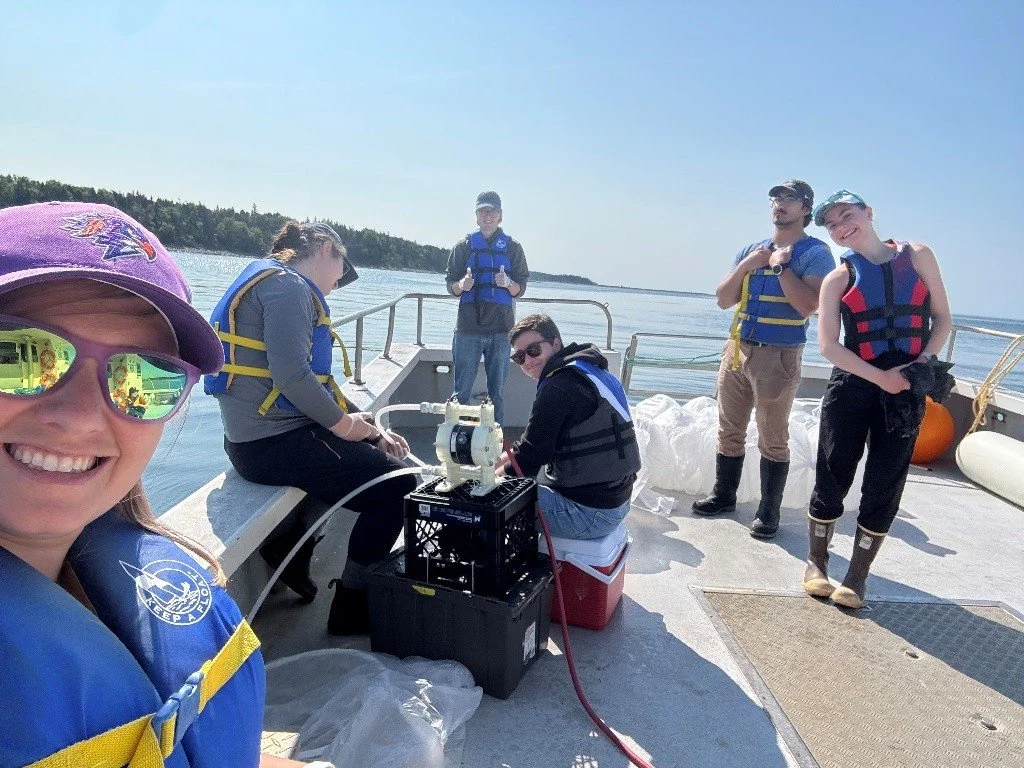
Buchwald and lab members preparing mesocosm experiments for the Halifax Harbour’s ocean alkalinity enhancement project. Photo courtesy of Carly Buchwald
Oceans play a vital role in regulating our climate and, as the climate is increasingly changing, it’s never been more important to protect ocean health. Coastal communities, like many here in Atlantic Canada, are shaped and supported by the sea. Whether it be marine-related jobs, trade, transport, tourism, leisure, marine renewable energy, or by providing food security or a cultural connection, we rely deeply on the ocean.
Oceans as a carbon sink
There’s a lot going on just above, at, and beneath the surface, with the ocean serving as an important carbon sink. Since the industrial revolution, oceans have absorbed about a quarter to a third of human-created CO2 emissions. Without this sink, CO2 in the atmosphere would be much higher and global warming more intense.
Dr. Carolyn (Carly) Buchwald, a marine biogeochemist at Dalhousie University, says that “the ocean has two ways for regulating climate…physical mechanisms and biological mechanisms.” In the physical mechanism, also called the solubility pump, the ocean absorbs CO2 from the atmosphere, storing it primarily as bicarbonates. The ocean also stores carbon through a biological process where phytoplankton use photosynthesis to turn CO2 into organic carbon. Some of that carbon descends to the deep ocean as dead cells or debris, while some is eaten by zooplankton that themselves sink or produce fecal pellets that sink. Once that carbon reaches the deep ocean, it can be stored for thousands of years, much longer and more stably than in plants, trees, and soil.
Nitrogen – fueling the ocean’s carbon sink
Buchwald’s research is focused on nitrogen, how it moves and transforms in the ocean, and its interplay in the ocean’s climate-regulating role. She describes nitrogen levels as a limiting factor in phytoplankton growth, which itself fuels the biological half of the carbon sink.
"Nitrogen is a major nutrient, and in most areas of the ocean, it's the nutrient that runs out first….when that runs out, you limit the amount of primary production, which decreases the amount of CO2 that is sequestered in the oean."
Fixed nitrogen, the type that is biologically usable, gets removed in the ocean’s Oxygen Deficient Zones (ODZ) during processes where bacteria use nitrogen to breathe instead of oxygen. With more ocean warming, ODZs are expanding and could result in more of the ocean’s nitrogen supply being stripped away. This is problematic because declining nitrogen could mean increased limitation of phytoplankton or primary production, meaning the ocean could reduce the amount of CO2 it is able to absorb.
Ocean acidification
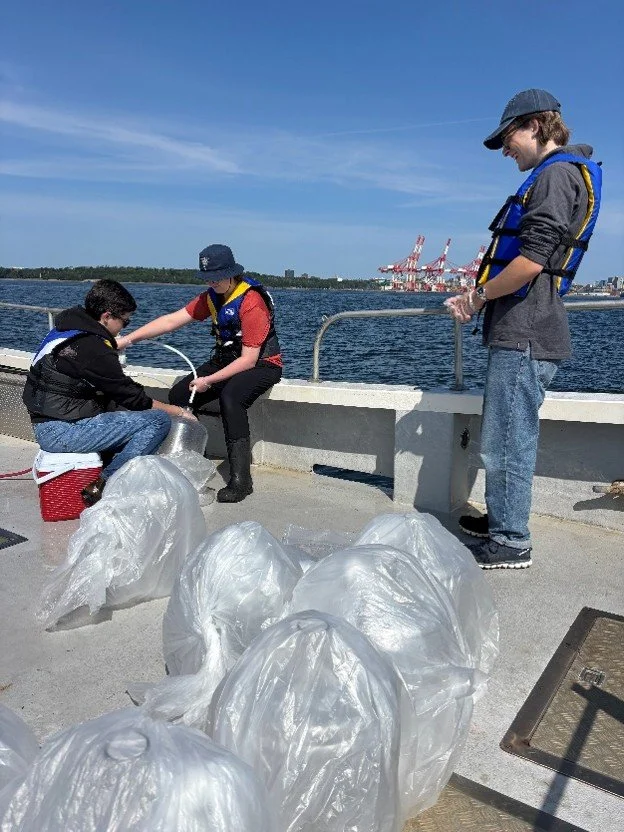
Members of Buchwald’s lab preparing mesocosm experiments for the Halifax Harbour’s ocean alkalinity enhancement project. Photo courtesy of Carly Buchwald.
As oceans continue to store CO2, surface-ocean pH has been declining, and in some areas is leading to ocean acidification. According to the Woods Hole Oceanographic Institution (WHOI), the ocean’s pH is currently around 8.1, representing a 26 percent increase in acidity from pre-industrial times. Under a business-as-usual high emissions scenario, WHOI estimates that seawater pH could drop to about 7.8 by 2100.
The effects of ocean acidification are felt primarily by calcifiers – think shellfish and corals – that need calcium carbonate to build their shells and skeletons. In more acidic water, shells become weaker and growth is slower. Dr. Kalina Grabb, a post doctoral fellow and Research Lead for Ocean Frontier Institute's CONVERGE CDR program at Dalhousie University, has spent time studying ocean acidification.
"The ocean has a large buffering capacity, but when CO2 is absorbed without shifting CO2 into more stable forms of carbon within the ocean, as Marine Carbon Dioxide Removal (mCDR) methods propose to do, it can lead to ocean acidification. Some areas have already pushed the ocean past its tipping point for ocean acidification, but it can be hard to tell where this tipping point is for specific areas,” Grabb says.
The mCDR methods Grabb refers to are proposing to alter the buffering capacity of the ocean and remove CO2 from the surface waters through engineered techniques or by directly incorporating it into biomass. Ultimately, mCDR methods propose to increase the safe storage capacity of CO2 without increasing the risk of ocean acidification.
Warming ocean
In addition to stressors like acidification, we’re also witnessing a warming ocean. As stated by WHOI, the top 2,300 ft of sea water has warmed about 1.5°F since 1901, and scientists found that the rate of warming in the top 6,500 ft of the ocean over the past few decades was 40 per cent higher than previously estimated. Marine heatwaves have also doubled since the 1980s and will continue to be more frequent, according to the Intergovernmental Panel on Climate Change (IPCC). These heatwaves can lead to coral bleaching, which starve coral reefs and weaken their ability to rebound from such stress events.
Multiple stressors
Ultimately, there’s a lot at play in the oceans as a result of a changing climate. Of these stressors, says Grabb, "The hard part is they're all connected…I find it hard to isolate a single stressor as causing the most harm, but it's the increase in the frequency of events as well as the compounding factor of multiple stressors."
In response to these multiple stressors, the ocean is ever changing, as may be its carbon sink.
The IPCC’s Sixth Assessment Report, looking at past and projected changes in the oceans, shows that carbon processes are starting to change in response to the growing carbon sink and that it’s expected to weaken under sustained medium-to-high emissions scenarios, though, the IPCC stops short of saying that this weakening is currently detectable in the 1960-2019 sink trend; rather, it’s something to watch.
Ocean-based climate solutions
Having studied diseased coral firsthand, Grabb says, “I was on the response side of the climate impacts.” From that experience, she began asking: “Now, what do we do? I really wanted to get to the point where we were preventing that impact, and so that's now why I study potential climate solutions.”
At CONVERGE mCDR, Grabb is working with a team of experts in interdisciplinary research on responsible and equitable marine carbon dioxide removal (mCDR).
"We need rigorous science to investigate these potential solutions so that we can make better decisions," says Grabb.
With input from the consortium’s members, Grabb led a process to co-design the program's research agenda, which is focused on Indigenous engagement and answering questions that matter most to communities. CONVERGE mCDR’s work focuses on areas of science, engagement, economics, and policy to bring about greater knowledge and understanding of the impacts and promise of mCDR techniques.
About the promise of mCDR, Buchwald says, "The promise is to take in the CO2 that we're emitting to the atmosphere and into the ocean…and it's necessary to explore these removal options while also reducing our emissions. Both are important.”
Through CONVERGE mCDR, Buchwald and Grabb are looking to predict how mCDR techniques, like ocean alkalinity enhancement in the Bedford Basin, may affect nitrogen cycling, with implications for nutrient dynamics, water quality, and greenhouse gas feedback.
Crediting Buchwald, Grabb says: "One thing that Carly always says is…whether or not we identify the perfect solution…resources are being poured into interdisciplinary collaborations across sectors to study the ocean. So, we're learning a ton more about the ocean by doing this research. Maybe this doesn't lead to a carbon removal strategy, but it may lead to knowledge about how to better protect our coasts better.”
As this research on mCDR techniques continues to unfold, it’s the hope that this work will be a meaningful step towards protecting the ocean’s continued ability to regulate our climate.
This story is part of a special series on marine-based climate solutions that is supported by the Carbon to Sea Initiative, the Marine Environmental Observation, Prediction and Response Network (MEOPAR), and Planetary Technologies.