Eyes and ears on the water
How fishers can work with, learn from, and ultimately contribute to OAE research, to the benefit of all.
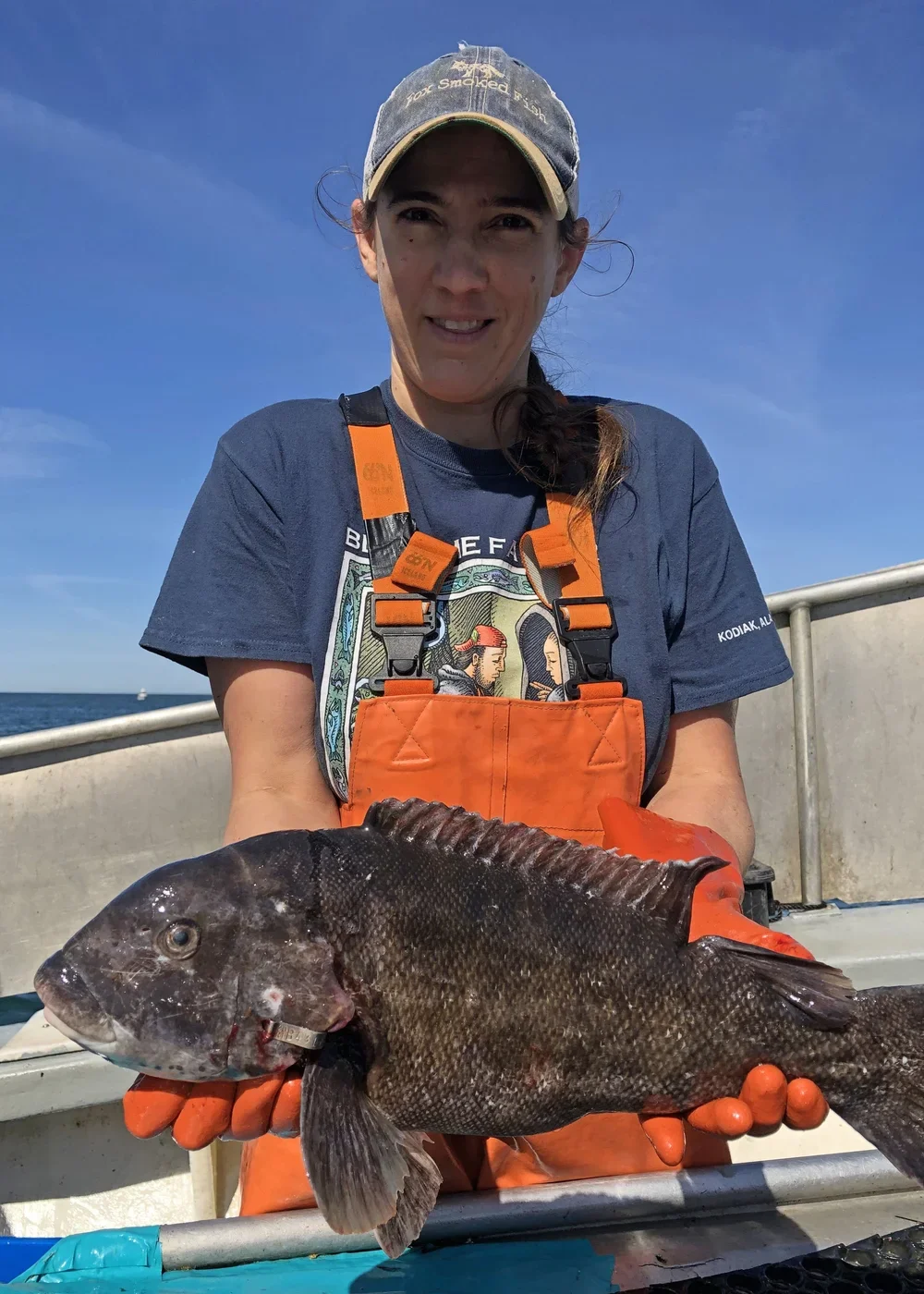
Sarah Schumann and friend. Photo courtesy of Sarah Schumann.
Sarah Schumann makes clear that she is “definitely not a scientist,” describing herself rather as a fisherman who has taken on the role of social science researcher and community organizer in the emerging field of marine carbon dioxide removal (mCDR) and specifically, ocean alkalinity enhancement (OAE).
Schumann, who fishes commercially for bluefish out of Warren, R.I., is one of a growing number of people in the fishing industry who are learning more about and becoming involved in observing the development of ocean-based carbon removal and storage techniques. She says she began looking into mCDR in 2022 after a researcher with the National Oceanic and Atmospheric Administration raised the issue with fishermen in Alaska, where Schumann also fishes.
“(The researcher) kept meeting with fishermen and talking about ocean acidification and they were like, ‘What can we do?’” says Schumann, who is also the director of the Fishery Friendly Climate Action Campaign, which helps fishermen, processors, and seafood workers shape climate and energy policies.
“The researcher found out about this thing called marine carbon dioxide removal and ocean alkalinity enhancement. That was the first time I had heard of it, so I immediately started paying attention. It was something to get a lot more fishermen involved in so that they can start paying attention too,” she says.
She learned about OAE, one of the most promising approaches to removing CO2 from the atmosphere. It uses seawater’s natural chemistry to convert dissolved CO₂ into carbonate and bicarbonate, allowing the ocean to absorb more CO₂ and store it for thousands of years. Scientists describe it as an antacid for the ocean since it neutralizes acid in the water.
Schumann says fish harvesters are somewhat wary of the technology, which is still in the research and development stage, with scientists around the world trying to answer fundamental questions about how effective it is, what the environmental effects could be and how those effects can be measured.
Those questions are particularly important to the fishing industry, which sometimes relies on the same waters where experiments take place for its livelihood. Because of that, fishermen in areas where mCDR research is being done are eager to be part of the scientific studies and “bear witness to it” Schumann says, while the groups doing the work have recognized the importance of including them.
“Fishermen like to get involved in research because we learn from it,” she says. “There's an inherent value in having a dialogue with members of the scientific community, sharing observations and comparing notes with scientists. In the case of mCDR, part of the drive to be involved is because we want to see it with our own two eyes.”
Schumann has become somewhat of an ambassador when it comes to sharing information with people in the fishing industry and spoke to Canadian fishermen at Carbon to Sea Initiative's annual convening last April in Halifax, where she discussed how commercial fishermen can be partners in OAE field research. Fisheries leaders also toured different sites in the city, learning about how Dartmouth-based Planetary Technologies, for example, is using alkaline materials in Halifax harbour to remove CO2.
Ginny Boudreau, manager of the Guysborough County Inshore Fisheries Association, participated in the sessions and said it’s critical that fishermen are more than just educated about OAE, but are part of the information sharing around its implementation.
“Harvesters definitely need to be involved with the research or the process of doing it after they have an understanding of it,” she said from her home in Canso, N.S.
“As a representative, I'm going to go out and get as much information as I need to pass along to the fishermen, to say, ‘Hey guys, this is coming. You guys need to be involved and this is how you can be involved.”
Schumann outlined how fishermen can be involved in mCDR research, citing the OAE LOC-NESS field trial off Massachusetts in 2025 in which fishermen played a critical role in making the project more “fishery sensitive.” Schumann, who acted as a fishing industry observer during the trial, says consultations with fishermen influenced the timing and location of the trial, and prompted pre-field-trial laboratory testing on zooplankton.
She says fishermen – the “eyes and ears on the water” -- can also help research teams design projects and do impact assessments by sharing their ecological knowledge with them when it comes to water temperature, fish behaviour, bottom type and environmental anomalies. Planetary Technologies, for example, consulted with the fishing industry for their project at Tufts Cove and added certain lobster larvae studies to its work after getting feedback from harvesters.
Fishermen can also use their boats and fishing gear in data collection before, during and after a field trial, according to a document Schumann helped create that outlines how fishermen can be involved in mCDR work, including collecting water samples for lab analysis, and assisting in the deployment of autonomous underwater vehicles and sensors that collect ocean data.
Organizations advancing mCDR research in Halifax have invited community and fishing groups to participate in research proposals, using a 2026 Joint Learning Opportunity involving Carbon to Sea, the Marine Environmental Observation, Prediction and Response Network (MEOPAR), and Planetary to help advance research into the removal technologies.
“It’s become standard for fishery science to collect data and analyze data in concert with commercial fishermen,” she says. “So now part of the role I play is to introduce ourselves to biogeochemists and other scientists and say, ‘You know, if you're coming to the ocean near us maybe involve us a little bit. Here's how we can get involved.’”
This story is part of a special series on marine-based climate solutions that is supported by the Carbon to Sea Initiative, the Marine Environmental Observation, Prediction and Response Network (MEOPAR), and Planetary Technologies.