Giving credit
Taking a look at the potentially game-changing carbon credit market for researchers and companies working in the fields of Ocean and River Alkalinity Enhancement — a crucial piece of the carbon removal puzzle.
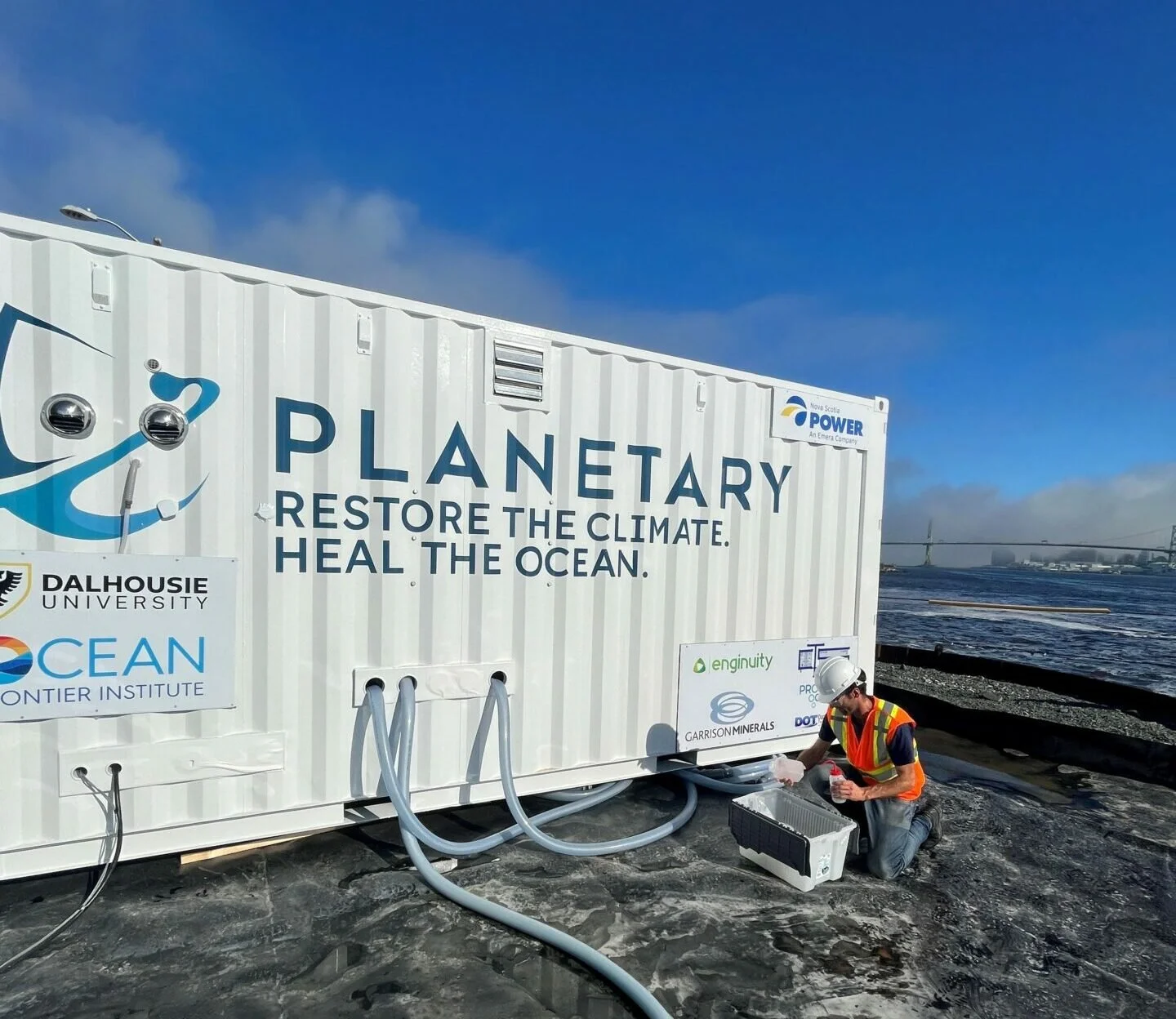
Planetary’s Will Burt working at the site’s automation and monitoring system set-up. Photo courtesy of Planetary Technologies.
Luke Connell was working at a non-profit in Toronto in 2020 around the time the Intergovernmental Panel on Climate Change issued a disconcerting warning: without pulling carbon dioxide out of the atmosphere, the goal of achieving net zero emissions and limiting global warming to 1.5C would likely be out of reach.
The international group of scientists made clear that emissions reductions were not enough to meet stated targets and that carbon dioxide removal, or CDR, would be required to counter-balance emissions from certain sectors and that the “future deployment of CDR will require rapid and sustained upscaling,” according to The Intergovernmental Panel on Climate Change (IPCC).
Rattled by the bleak assessment, Connell reached out to a leading climate scientist who connected him to two researchers in Halifax who were using a decades-old river restoration approach: they were adding finely crushed limestone to acidified rivers to raise pH levels and rebuild salmon populations.
But the researchers had stumbled onto something unexpected: the same technique was also helping the limed rivers draw down measurably more carbon dioxide than untreated rivers. The approach, known as River Alkalinity Enhancement (RAE), not only balanced acidity in the rivers but also absorbed carbon dioxide and transported it to the ocean where it would be stored for thousands of years.
And CarbonRun is not the only carbon removal company active in Nova Scotia. Planetary Technologies, founded in 2019, works on seawater restoration to rebalance the climate through Ocean Alkalinity Enhancement (OAE).
Planetary integrates directly into existing outfall locations such as Nova Scotia Power’s generating station at Tuft’s Cove on the Halifax Harbour. Its work reduces ocean acidity, which in turn allows the ocean to absorb more CO2 from the air.
IPCC calls for carbon removal had fuelled a boom in CDR startups, but it was when heavyweight tech company Microsoft and others announced in the early 2020s that they would spend billions buying up CDR credits on the emerging carbon removal credit market that Connell saw opportunity.
“I said, ‘Hey, forget the research track. Let's start a company and scale this with commercial CDR demand,” Connell, who joined the two Nova Scotia-based researchers, Dr. Shannon Sterling and Dr. Eddie Halfyard, in forming CarbonRun as its CEO, said from his home in Toronto.
“All the companies in the CDR space were ignited by that idea. So, I would say 80 per cent of the current CDR companies were all founded between 2022 and 2023.”
The goal for the new companies was to sell credits to buyers interested in offsetting their own emissions or meeting climate targets. But how does the carbon removal credit market work, how does it benefit companies like Planetary and CarbonRun, and where is it headed?
Carbon removal credits are generated when a project removes carbon dioxide from the atmosphere and stores it for the long term. One credit typically represents one tonne of carbon dioxide removed. There are two kinds of markets — voluntary and compliance markets. The voluntary market is the most widely used around the world and allows companies to buy and then retire a carbon removal credit so that they can’t be counted twice.
The United Nations describes the main difference between the two markets through the goals for which the carbon credit is used. In compliance markets, goals are established by governments or international treaties in a mandatory manner. In voluntary markets, individuals, companies, and governments set their own goals to meet voluntary commitments.
Central to this arrangement are buyers like Microsoft and Frontier, a so-called Advancement Market Commitment made up of companies like Stripe, Alphabet, Shopify, and Meta, that launched in 2022 with a pledge to purchase $1 billion in permanent carbon removal credits by 2030. Frontier says the idea is that “its team of technical and commercial experts facilitates purchases from high-potential carbon removal companies on behalf of buyers.”
Frontier would evaluate a CDR company’s technology and buy the credits once it has done its due diligence. The credits are then listed on a carbon removal registry, like Isometric, a science platform that certifies engineered and nature-based methods to permanently remove carbon dioxide from the atmosphere. It issues scientifically verified carbon credits, guaranteeing that every credit bought represents exactly one metric ton of durable, CO₂ removal, according to its website.
Frontier just announced an additional $915 million to help grow carbon removal companies. Participating buyers include Stripe, Google, Shopify, Salesforce, H&M Group, and Anthropic, raising Frontier's total commitment to $1.8 billion, it said in a June 17 release.
Revenue from the sales of credits helps CDR companies stay afloat, continue their research, and continue to advance their carbon-removal methodologies, which include everything from direct air capture and mineralization to biomass-based removal and storage, and marine carbon removal.
Planetary Technologies was the first OAE company in the world to have credits verified by Isometric. The credits were based on its pilot projects in Halifax, where magnesium oxide is introduced into the water and monitored with measurement protocols. The antacid neutralizes acidic CO2, storing it in the ocean, in a stable form, for up to 100,000 years.
As more CO2 in surface waters is transformed into these natural deposits, more atmospheric CO2 in turn, is pulled back into the water to reestablish equilibrium.
The company’s genesis was driven by CEO Mike Kelland’s desire to make a climate impact. He connected with Greg Rau, one of the first researchers to look at marine carbon dioxide removal and now Planetary’s co-founder and senior scientist, and they decided to develop his leading work around ocean alkalinity enhancement into the business.
In 2025, Frontier buyers signed a $31.3-million offtake agreement with Planetary to remove more than 115,000 tons of CO₂ between 2026 and 2030.
Will Burt, a chemical oceanographer and Planetary’s vice-president of science and product, says the process of getting verified is intensive and includes everything from running ocean models and building code to collecting massive amounts of in-ocean measurements to be submitted to the verifying agency.
“It is a lot of work every time and takes a little under two months from start to finish,” he says. “It’s kind of product development and that's why my title is not just science, it's also product, because generating these credits in a scientifically robust, cost-effective, and reproducible way is what Planetary offers to the world.”
CarbonRun was also instrumental in Isometric’s May 2025 development of a certified protocol for carbon dioxide removal through River Alkalinity Enhancement, setting a global standard for quality, measurement, and accountability in that kind of carbon removal.
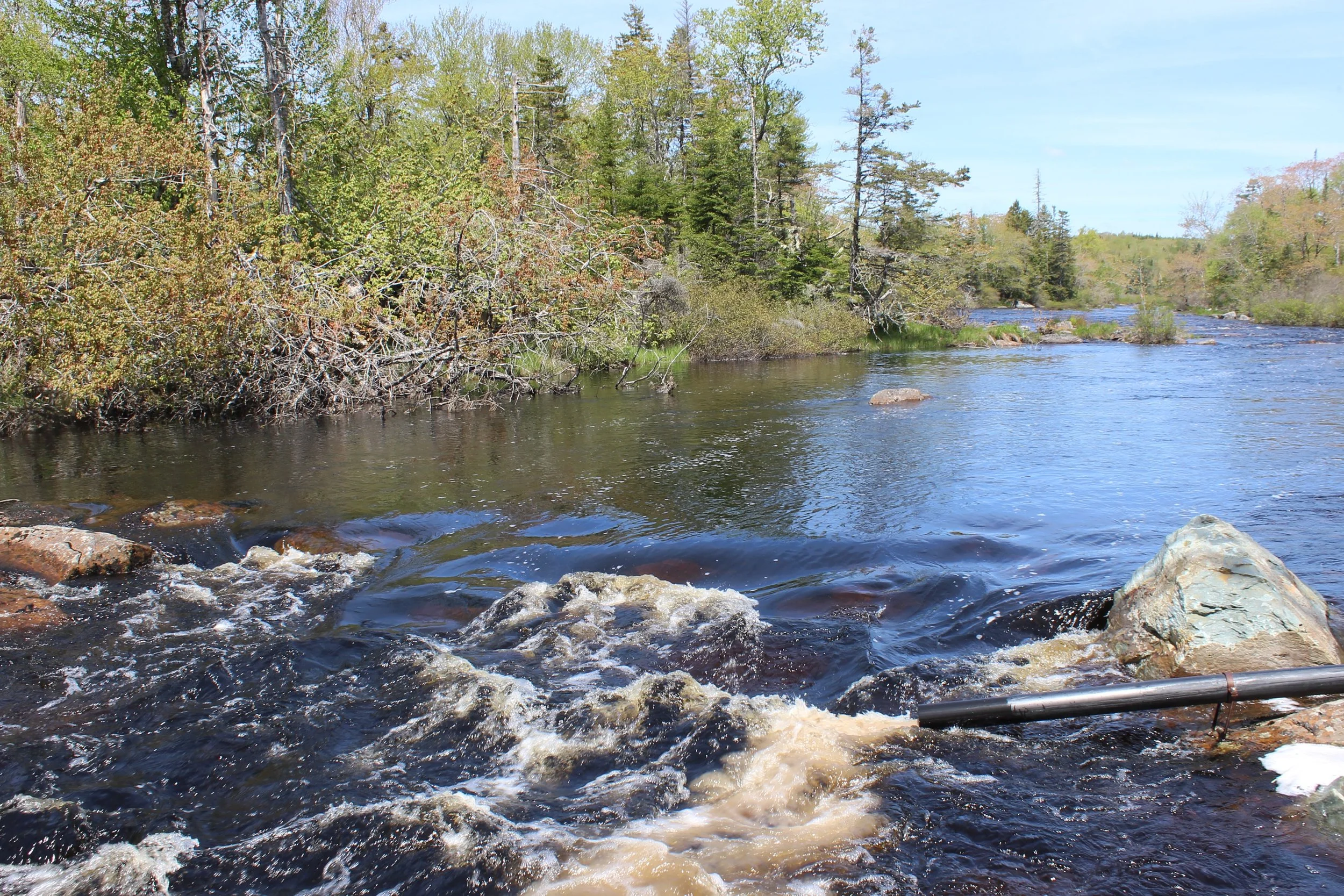
CarbonRun’s new Moser River dosing operations (see pipe on right side of photo). Photo courtesy of Dalhousie University.
“By creating a clear, science-backed framework for how to do river-based CDR right, this protocol makes it easier for more groups to participate and for buyers to purchase with confidence,” CarbonRun said in a release at the time.
The sector is gaining traction globally. CDR.fyi, an open CDR registry and data platform tracking the global market, states that more than 49 million tonnes of CDR have been sold since 2019 — to be delivered by agreed upon dates.
Canada is emerging as a significant player in the space since the country possesses extensive forest resources, large areas of agricultural land, extensive coastlines and ideal ocean chemistry, and favorable geological formations for underground carbon storage.
The federal government has also established a procurement program specifically for carbon dioxide removal, which would eventually allow it to buy carbon dioxide removal credits and apply them towards its own net-zero commitments. Those credits could be used, for example, for National Defence to offset emissions from jet fuel. The program does not yet include marine-based carbon removal, but several groups have been advocating for its inclusion.
“There's an initial commitment of $10 million and we see that as a really kind of positive early demand signal in Canada, so we're watching that quite closely and we'd love to see that program continued and scaled up over time,” says Melissa Hillier, associate director of policy at the Carbon Business Council.
“I think there’s a recognition within the government of Canada that this is an important industry and growing opportunity for Canada, so there’s a desire to support that early learning and development of the industry.”
And the number of CDR companies in Canada has risen in recent years. Daniel Kelter, senior director of public affairs at the independent, non-profit Carbon Removal Canada, says it’s tracking about 93 companies in Canada — which has grown from about 73 in 2023.
The group recently released a report called Removals into Revenue, which framed carbon removal as economic infrastructure that by 2050 could generate $78 billion in Canadian GDP, along with 300,000 jobs. Achieving those numbers would require higher decade-long government procurement and enabling carbon removal to generate credits in domestic compliance markets, like the Output-Based Pricing System and Clean Fuel Regulations.
“Almost all international bodies that are quantifying the world's progression to net zero now agree that some amount of permanent carbon removal is the only path viable to hit net zero by 2050,” Kelter says.
“And if we structure this in the right way, this doesn't have to be detrimental -- this is something that is additional, that allows companies to grow and hit their climate targets at the same time. And ultimately, I think that is one of the most acceptable types of climate policy or climate inventions that's out there.”
**
This story is part of a special series on marine-based climate solutions that is supported by the Carbon to Sea Initiative, the Marine Environmental Observation, Prediction and Response Network (MEOPAR), and Planetary Technologies.