mCDR technology is a green economy win-win, helping to fight the effects of climate change while at the same time providing huge economic spin-off benefits. Some might say, a no-brainer.
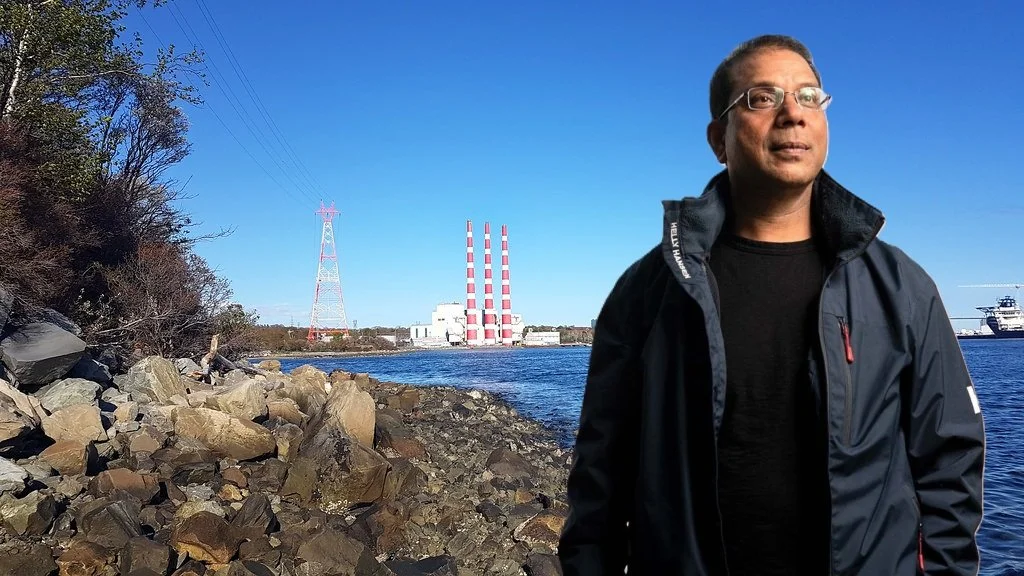
Akash Rastogi, chief capital strategy officer at Canada's Ocean Supercluster (OSC). Inset photo of Mr. Rastogi courtesy of Ivey Business.
When Italian physicist Cesare Marchetti published a study in 1977 outlining how the ocean could be used to manage carbon dioxide, his novel theory received little attention aside from some naysayers who questioned the efficacy and safety of such a proposition.
His idea involved capturing CO2 from industrial smokestacks and injecting it into deep ocean currents in the Mediterranean, allowing it to be carried into deeper waters where it could remain isolated from the atmosphere for centuries.
The concept – coming decades before marine carbon dioxide removal (mCDR) emerged as a climate-technology industry - did not become a commercial carbon-storage system but helped spark the scientific exploration of the ocean's enormous potential as a place to store carbon.
It was an important moment in the evolution of CDR techniques and fuelled the development of mCDR approaches which have become a critical piece of global strategies to reduce atmospheric carbon, while also proving to be valuable revenue and job creators.
“Normally a lot of climate action requires compromising or a trade-off with economic growth. The story here is that mCDR can actually provide both,” says Akash Rastogi, chief capital strategy officer at Canada's Ocean Supercluster (OSC).
“It'll allow us to mitigate climate change impacts while contributing significantly to Canada’s economic growth opportunities. And that's really important as we transition to a low-carbon economy. And you can see that in the current administration's viewpoint: economics are as important as our climate commitments and so it allows you to do both of those things.”
The growth of mCDR technologies and initiatives in Canada have expanded significantly in the last decade, with the country considered a leader in pursuing the field. There are roughly 98 companies in the CDR industry in Canada, with mCDR businesses forming a subset of that.
But until recently little was known about the economic potential of the mCDR sector. That led Rastogi and colleagues to address the question in a 2025 report that examined how different mCDR techniques might combat climate change, add to the economy and generate a skilled workforce.
The findings were impressive.
The study estimated that mCDR, once scaled responsibly, has the potential to remove roughly 90 to 170 megatonnes (Mt) of CO2 a year from the atmosphere by 2050, representing about 1/6th of Canada’s current emissions. It cites an analysis by Carbon Removal Canada that suggests this country will need at least 300Mt a year of carbon removal capacity by 2050 to meet the Paris Agreement goal of 1.5C of global warming. mCDR could contribute roughly 40 per cent of this capacity need, while helping Canada meet its nationally determined contributions (NDCs) to reduce emissions by 45 to 50 per cent below 2005 levels by 2035.
There are different mCDR approaches included in this estimate: biogenic, which involves sinking micro- and macroalgae; geochemical, which uses adding alkaline rocks to the water to draw down atmospheric CO2; and, synthetic, which uses machines to extract CO2.
Factoring in these techniques, the OSC report estimated that by 2050 the mCDR industry could provide about 100,000 jobs across Canada, contribute between $7 billion and $20 billion to the GDP and generate $50 million to $140 million in federal and provincial tax revenues.
“If you try to compare those numbers -- jobs, GDP and investment potential -- they are pretty similar to the numbers Canada's current electricity generation sector produces,” says Rastogi. “So, by 2050 it can be as big as Canada's electricity utility sector.”
CDR companies are operating across the country, with the Atlantic and Pacific coasts already hubs for the development of mCDR approaches through partnerships with academic institutions and organizations focused on the development and scaling of marine technology. Nova Scotia is home to two pioneering companies using alkalinity to remove carbon dioxide from the atmosphere. Planetary Technologies adds alkalinity to seawater to increase the ocean’s uptake of CO2. Its Tufts Cove project generated the world’s first independently verified marine carbon removal credits. CarbonRun adds lime to rivers to reduce their acidity and help carry dissolved carbon downstream to the ocean for long-term storage, preventing it from returning to the atmosphere.
While still considered a nascent industry, mCDR has become a is garnering increasing attention. In September, a Senate committee issued an extensive report on carbon removal, called From Air to Sea: Canada, A Leader in Restoring Ocean Ecosystems and Fighting Climate Change.
The government recognized the importance of the technology and responded positively to the committee’s nine recommendations intended to advance the field, saying that “a variety of carbon dioxide removal (CDR) methods will be needed to meet our climate goals...(and) recognizes the early potential of mCDR approaches, including ocean alkalinity enhancement.”
Daniel Kelter, senior director of public affairs at Carbon Removal Canada, says both the Senate report and the government response bring mCDR into the mainstream, making it a credible, economically beneficial part of climate change strategies.
“I think it's a really important kind of landmark because it's the first time that a government political body has done an in-depth look at mCDR and what it would take to actually scale the sector,” he said. “It's sending an important signal that there are serious people talking about this and really seeing the climate and economic opportunities here but also understanding how we have to go about this in the most methodical approach.”
The last point is important, Kelter says, because he argues that Canada is not keeping pace with other countries when it comes to developing the sector through investments in research, verification work, demonstration projects and capacity expansion. In a newly released report called Tracking the Tonnes 2026, Carbon Removal Canada says there are 16 carbon removal projects in six provinces, with the capacity to remove 98,250 tonnes of carbon dioxide a year. That is triple the amount in 2023, but capacity hardly grew this year and two million tonnes are needed by 2030 to stay on track, the report states.
“We are building things in Canada, but not nearly fast enough,” says Kelter. “There’s significant opportunity for mCDR to scale and to scale economically. If we get some of those policy conditions and environmental considerations right, this could be one of the largest carbon removal sectors, but we won’t get there unless we’re scaling the sector today.”
This story is part of a special series on marine-based climate solutions that is supported by the Carbon to Sea Initiative, the Marine Environmental Observation, Prediction and Response Network (MEOPAR), and Planetary Technologies.