Irene Polnyi used her consulting expertise to pick the most promising way to fight climate crisis. She decided it was OAE.
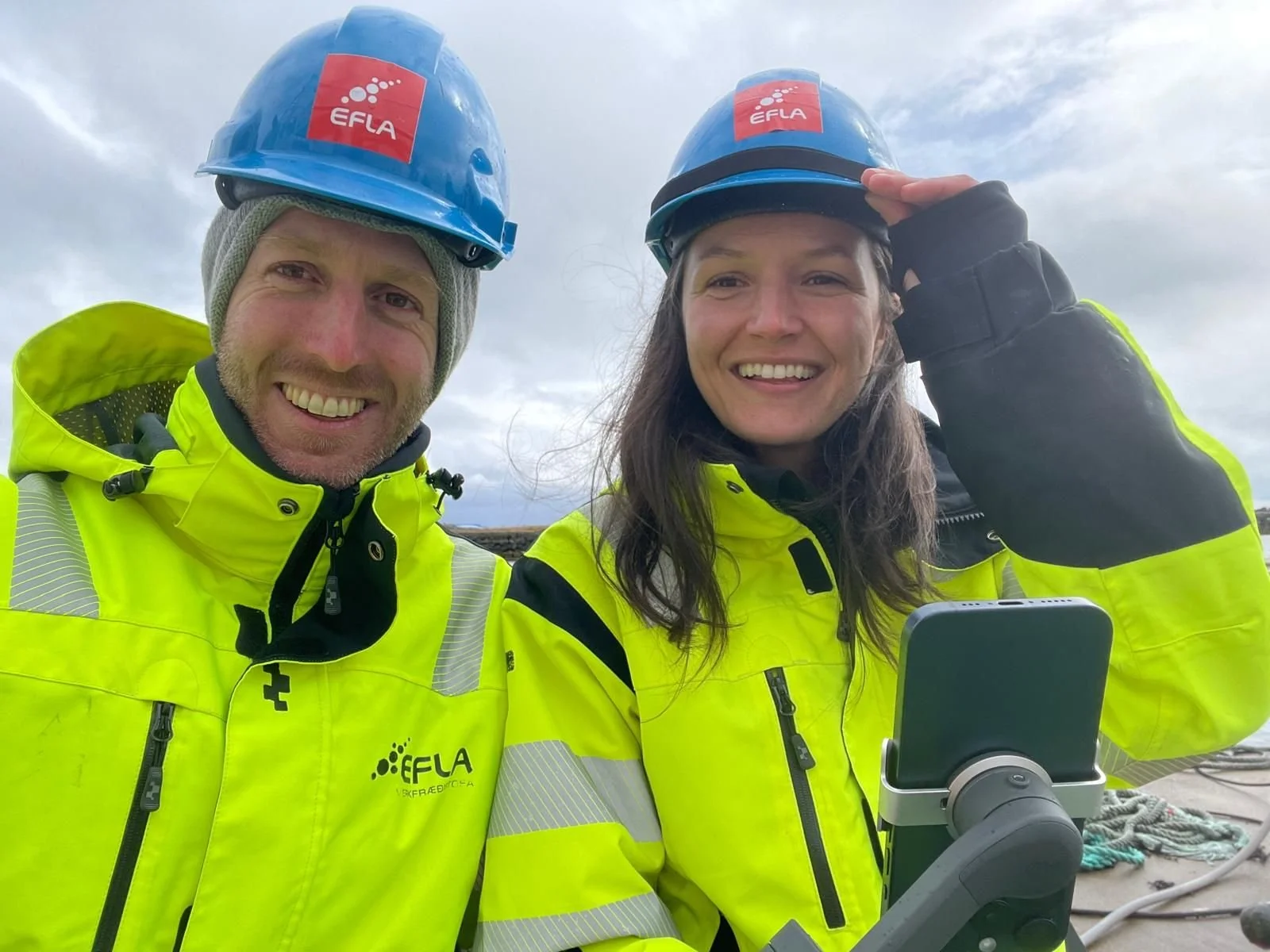
Polnyi with Carbon to Sea executive director, Antonius Gagern, on a field site visit to Hvalfjorour, Iceland. Photo courtesy of Carbon to Sea Initiative.
Irene Polnyi may live in Brooklyn, but she spends her days thinking about the world’s oceans — specifically, how they can help reduce carbon in the atmosphere and lessen the effects of climate change.
The Vice President of Research and Development for the Carbon to Sea Initiative, Polnyi helps identify promising sites around the world for ocean alkalinity enhancement (OAE) research and works with local partners to fund and deliver OAE projects. Carbon to Sea is currently funding research sites in Nova Scotia and Iceland — the first in what will soon be a global research network.
It’s quite a change from how Polnyi started her career.
“I studied economics,” she says, with a smile. “I was a management consultant for most of my professional life.”
But after more than a decade working for a global consulting firm and as a strategic advisor for companies in the tech space, Polnyi had an awakening in the mid-2010s. It’s not that she wasn’t aware of critical problems in the world before that, but what hit home for her was a sense of urgency.
“When times are comfortable, when there's peace in the world, you can have lots of fun helping companies compete with one another, launch new products, and reach new consumers, but then that all starts to feel a little bit small, doesn't it?” says Polnyi, who was born in Ukraine, but has lived in New York City since she was 18. “I decided that I wanted to go and apply my skills towards organizations that needed my attention a little bit more.”
So she left the corporate world and became one of the founding team members of Article Group, a non-profit that works with activists and foundations to create positive change.
Polnyi’s work with the group “was all about human rights and democracy building in Thailand and Myanmar.” She was involved in supporting groups repatriating Thai and Burmese fishermen trapped at sea in slave-like conditions, as a result of being forced to go farther and father offshore because of inland overfishing. “So I really got to see, front line, the human devastation that was caused by climate change,” she says.
Working with author and activist Paul Hawken, who edited the book Drawdown, which proposed solutions to reverse climate change by removing carbon from the atmosphere, made Polnyi realize she wanted to devote herself to the field.
“I thought, ‘I need to be working on climate change for the rest of my life. If I'm not working on climate change, I don't know what I'll be doing,’” she says.
To decide where to best focus her efforts, Polnyi applied her management consultant’s lens, spending months evaluating different approaches to reducing atmospheric carbon, and determining where she could have the greatest impact as someone who was not a scientist.
“One of the ones that kept coming up was ocean alkalinity enhancement,” she says. “I learned just how much carbon is stored currently in the ocean, and I thought, well, that's pretty interesting. The underlying mechanism behind why there's 38,000 gigatons of carbon stored in the ocean is effectively this concept of ocean alkalinity. And if you can enhance that process or speed it up, you could potentially make a really meaningful impact in the climate crisis... So that’s when I reached out to Antonius.”
“Antonius” is Antonius Gagern, now the Executive Director of Carbon to Sea.
Today, Polnyi’s position as head of R&D allows her to put her goal into practice, helping to “accelerate the pace of learning, accelerate the pace of science, and help people understand and adopt what’s coming out of the academic community.”
One of the key elements of that work is collaborating with partners to launch new research sites. To that end, Polnyi is heading Carbon to Sea’s a new global research network, with field sites testing the effectiveness of OAE.
Polnyi says in some cases, Carbon to Sea will be funding organizations that “already have a research permit, are looking for research funding, and are completely ready to go. They're staffed with scientists and operators, and they have all the vessels and equipment that you would need.”
In other cases, Carbon to Sea is dealing with “folks who are a little earlier on in their journey,” Polnyi says.
“Perhaps they're in a region that is new to exploring OAE. Maybe they are from an adjacent academic field and they're looking to expand into OAE, so they might need a little bit more support. So we're really flexible as an organization. I've got folks on my team who could help set up an entire budget for an organization, and we have a lot of experience that we can lend out as needed.”
Sites are run independently, but with support from Carbon to Sea.
“We have a strategy that all of the field sites would be led and operated locally. So we would be recruiting for CEOs, helping them start their own nonprofits, funding that work, and helping to connect them to the global R&D priorities,” Polnyi says.
Of the current field sites, Nova Scotia was already involved in a partnership between Planetary Technologies and Dalhousie University, before Carbon to Sea came aboard. In Iceland, the site at Hvalfjörður is run under the leadership of the Röst Marine Research Center (Polnyi sits on the board) and will serve as a research hub, bringing together scientists from a number of non-profits and other research organizations.
For Polnyi and Carbon to Sea, there is no one-size-fits-all approach. The important thing is advancing the research.
“A lot of people go into the ocean sciences because they grew up on the ocean, or they have a love of the ocean, or they're surfers or scuba divers, or something like that. That hasn't been my experience. I came to this work very objectively — what is quite literally the biggest potential opportunity,” she says. “It sounds so cringe, but I wake up every day wanting to solve climate change. That is my primary motivation. Whether it's this or that, whether it’s on ocean or on land, those things to me are not all that important. What's important is, what can actually work.”
This story is part of a special series on marine-based climate solutions that is supported by the Carbon to Sea Initiative, the Marine Environmental Observation, Prediction and Response Network (MEOPAR), and Planetary Technologies.