Community engagement and OAE are two sides of the same coin: can’t have one (be successful) without the other.
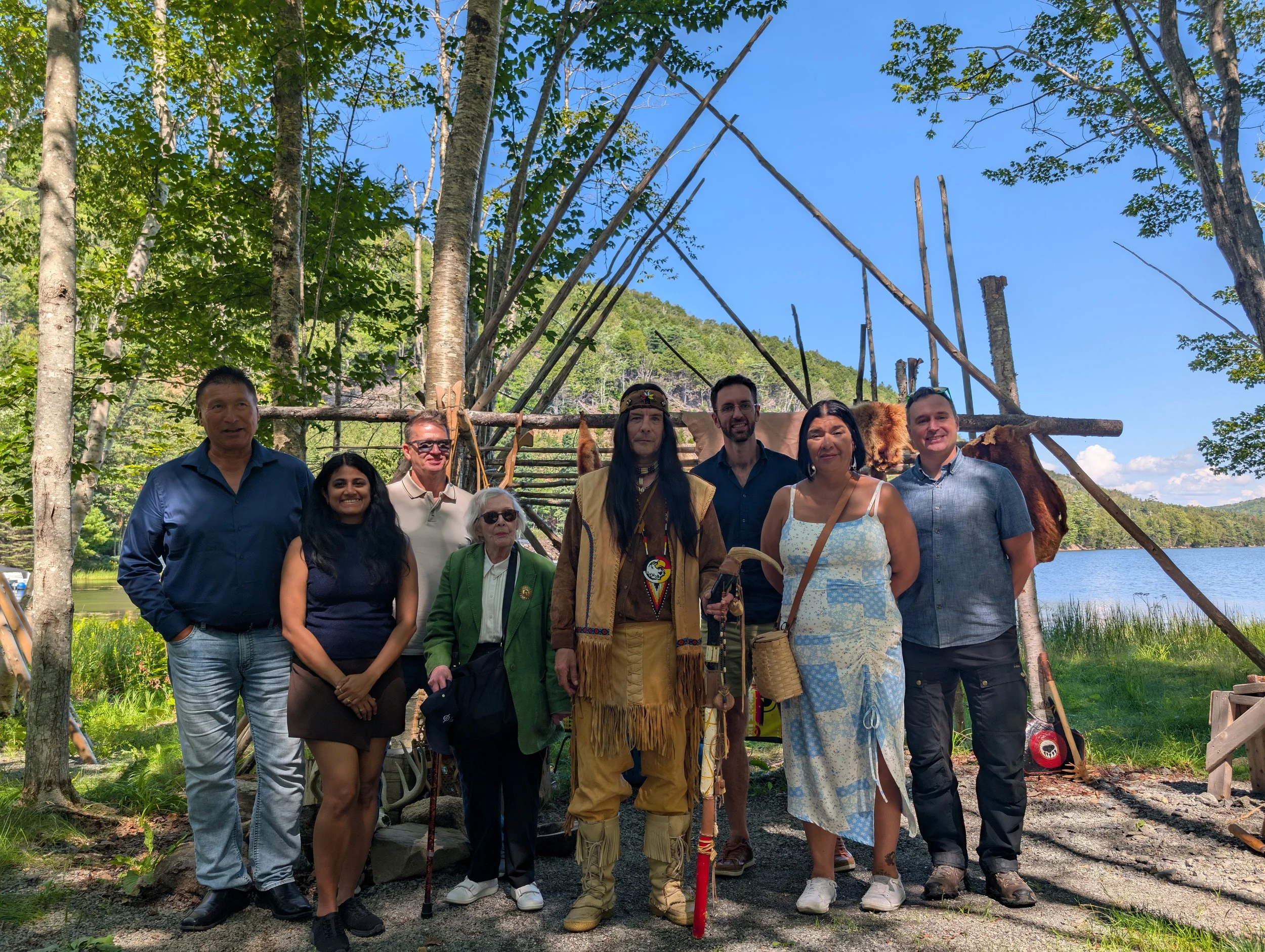
Two-Eyed Seeing committee group photo from Eskasoni. Photo courtesy of Planetary Technologies.
Over three days in September 2022, Planetary Technologies worked with local utility South West Water on a pilot at Hayle Wastewater Treatment Works in Cornwall, England. Diluted magnesium hydroxide was added to the treated wastewater which flowed through the existing outfall to the sea near St Ives Bay in Cornwall, England. In April 2023, months after the three-day pilot ended, the protestors gathered on the beach to raise concerns about the project.
“It’s a bit unfair to always talk about Cornwall,” says social scientist Sara Nawaz, director of research with American University’s Institute for Carbon Removal Law and Policy, “but it’s such a good cautionary tale.”
Ocean Alkalinity Enhancement, or OAE, is a process whereby the alkalinity of ocean water is subtly increased — with the addition of what is essentially large antacids — to help it absorb and sequester more carbon from the atmosphere.
Community engagement isn’t just about getting permission, says Nawaz. It’s about getting area residents up to speed on the science, getting a sense of their knowledge of the water, infrastructure, and institutions involved, and, of course, giving them the opportunity to say no, long before any magnesium hydroxide hits the water.
Engagement takes time, she says, and needs to start early, with an emphasis on forming partnerships, reaching a representative number of residents, and understanding a community’s history and culture so projects can be proposed in context. This is as much for the success of OAE as it is for the consent and wellbeing of locals — as demonstrated in Cornwall.
In Elizabeth River, Virginia, where Planetary carried out field demonstrations over two weeks in 2024 and 4 weeks in 2025, those conversations began early
“The first thing we ask is, are you comfortable with what we’re proposing?” says Diana Philip, vice president of community and government relations with Planetary Technologies. “The moment that kind of power is given to the community, they’re usually surprised. Like, really? You care what we think?”
These conversations begin 12-18 months ahead of any potential project, she says, and are had first and foremost with potential partners. In Virginia, these were the Chesapeake Bay Foundation and Elizabeth River Project, both heavily invested in watershed restoration and the wellbeing of this particular river. Add to these a suite of municipal partners, and they were in business.
The idea behind these partnerships was “co-creation,” says Philip, where the community takes an active part in project design. The importance of oysters to the local economy was impressed upon Planetary, for example, so a study of oysters in alkalized water became part of the pilot. The company also presented its work to the Elizabeth River Project’s Technical Policy Committee before, during, and after both field demonstrations to seek guidance and social approval.
In Nova Scotia, community engagement has grown alongside the Tufts Cove project where they operate more or less continuously at Tufts Cove, and where their most innovative partnership is with the indigenous Mi’kmaq. Planetary began engaging with local communities as it prepared for field demonstrations in 2023. That work has continued through open houses, site visits, and tea-table discussions, as well as ongoing engagement with Mi’kmaq communities and local fisheries. When Planetary asked local fisheries which species they wanted included in monitoring, beyond what regulators required, they asked for lobsters. Planetary thus added tests to look for potential effects on lobster larvae.
One manifestation of collaboration is a quarterly roundtable where Planetary sits down with Mi’kmaq leaders and Elders to enrich the science and technology of OAE with Indigenous knowledge and perspective. They also discuss community engagement efforts with the First Nations of Nova Scotia — what’s been done, what can be done better, etcetera — and the possibility of Mi’kmaq doing some OAE themselves.
There are plenty of ways to get a conversation going, says Philip, whether during educational sessions and site visits, or over a game of cup pong, which Philip and her team have used more than once to demonstrate the chemistry of OAE. Engagement can always start small, she says, and doesn’t have to be boring.
“Any solution anything that’s looking to scale will only have a future if it’s done with the community.”
This story is part of a special series on marine-based climate solutions that is supported by the Carbon to Sea Initiative, the Marine Environmental Observation, Prediction and Response Network (MEOPAR), and Planetary Technologies.